





































Open the average real estate agent’s Instagram profile, and you will probably see some version of the same feed: a just-listed graphic, a market update, a closing photograph, and then another just-listed graphic. That content proves the agent is working, but it does not always give someone a reason to follow and engage.
I recently interviewed Luke Acree, president of ReminderMedia, and he explained that agents often market too transactionally. His advice was that your Instagram should look more like reality TV than a commercial. Instead of showing only the finished transaction, let people see the work, personality, relationships, and everyday moments behind it.
That does not mean manufacturing drama or sharing every detail of your personal life. It means creating an account people find useful, entertaining, and relatable even when they are not ready to buy or sell. These Instagram marketing tips for real estate agents will help you build that type of presence while keeping the strategy realistic enough to maintain alongside your actual business.
- Defining Instagram marketing for real estate agents
- Building your Instagram foundation
- Making your Instagram feel more like reality TV
- Turning Instagram activity into relationships
- What real estate agents should not share on Instagram
- How to audit your real estate Instagram account
- Common Instagram marketing mistakes
- Frequently asked questions (FAQs)
- Your take
Defining Instagram marketing for real estate agents
Instagram marketing for real estate agents is using Instagram to build local visibility, demonstrate expertise, develop relationships, and create opportunities for prospective clients to start conversations. It includes more than publishing listing photographs or trying to accumulate followers.
A complete real estate Instagram marketing strategy includes your profile, branding posts, Reels, Stories, direct messages, comments, collaborations, and follow-up. Each part should help the right people understand who you are, where you work, what you know, and what it might be kike to have you as their agent.
The objective is not necessarily to become an influencer. An agent with a smaller audience of local homeowners, potential clients, past clients, and community partners may generate more relevant conversations than someone with thousands of followers scattered across the country.
Related read: The 8 Best Real Estate Marketing Companies for 2026
Building your Instagram foundation
Optimize your Instagram bio for local discovery and leads
Your Instagram bio is one of the first things someone reviews before deciding whether to follow or contact you. It should quickly answer three questions:
- Who are you?
- Where do you work?
- How can you help?
Include your name, role, location or market, primary area of expertise, and a clear next step. Your profile photograph should also be recognizable and consistent with the rest of your professional presence. If your username is difficult to spell or does not identify you, use the name field and bio to make your identity and business clear.

A bio might include:
- Your name and real estate role
- The city, region, or neighborhoods you serve
- The type of client or property you specialize in
- A brief differentiator
- Brokerage information required by your state or company
- A call to action
- A link to your website, consultation calendar, listings, or lead magnet
Avoid filling the limited space with vague claims such as “making dreams come true” or “your trusted real estate expert.” Be specific about what someone can expect from following or working with you.
The same principles that make a strong professional bio also apply across your website, listing presentations, and social profiles. For more help explaining your experience and value, use The Close’s guide to writing a real estate agent bio.
Decide who your account is meant to attract
Planning a real estate Instagram account becomes much easier when you know who it is for. Trying to reach every buyer, seller, investor, agent, and homeowner usually creates a feed with no clear direction.
Your primary audience might be:
- First-time buyers in your city
- Homeowners preparing to sell
- People relocating to your market
- Luxury buyers and sellers
- Real estate investors
- Downsizing homeowners
- Residents of a particular neighborhood
- Past clients and members of your sphere
Choosing an audience does not prevent you from working with other client types. It gives your content a clear starting point. A first-time buyer and an experienced investor will not necessarily care about the same properties or market developments.
Your audience should also influence the account’s tone. Someone helping nervous first-time buyers may adopt a reassuring, explanatory style. An agent marketing luxury properties may emphasize access, design, and local expertise. A relocation specialist may focus on what daily life looks like in different communities.
Do not measure the quality of your audience only by its size. A few hundred engaged followers who live in your market can be more valuable than a much larger audience that will never need your services.
Build your account around a recognizable point of view
Your point of view is what separates your Instagram account from the hundreds of agents who have access to the same listing photographs, market statistics, trends, and templates. It is the perspective followers learn to associate with you.

Consider what you want people to say when describing your content. Perhaps you are known for honest neighborhood comparisons, funny observations about agent life, access to luxury listings, renovation expertise, or practical advice for first-time homebuyers.
A recognizable point of view can come from:
- The clients you serve
- The neighborhoods you know
- Your previous career
- Your personal interests
- Your communication style
- Your opinions about the market
- Your approach to client service
- The questions clients repeatedly ask you
For example, two agents can post about the same mortgage-rate change and create entirely different content. One may explain what the change means for a first-time buyer’s monthly payment. Another may discuss how it affects investor cash flow. A third may advise sellers on preparing for a possible increase in buyer activity.
Do not invent a personality because you believe it will perform well online. A forced persona becomes difficult to maintain and can create a disconnect when someone meets you in person. The strongest personal brand is usually a more intentional version of who you already are.
Making your Instagram feel more like reality TV
Document your professional and personal life
A commercial shows the polished final product, while reality TV shows the characters, decisions, setbacks, conversations, and moments that led to it. Agents can apply that distinction by documenting more of what happens between taking a listing and posting the sold photograph.

Show followers how you prepare for a listing appointment, review comparable properties, set up an open house, coordinate photography, attend an inspection, or solve an unexpected transaction problem. Explain what you are working on without exposing confidential information.
Professional steps to document include:
- Preparing a comparative market analysis
- Walking through a property before photography
- Selecting photographs for a listing
- Previewing homes for a buyer
- Setting up an open house
- Meeting with a lender or contractor
- Reviewing inspection findings
- Delivering a closing gift
- Attending training or touring new construction
- Explaining a lesson from a recent transaction
Your personal life can be part of the story, too. Followers may connect with your hobbies, family, pets, routines, favorite restaurants, community involvement, travel, fashion, home projects, or the realities of balancing work with everything else.
Personal content gives people more ways to relate to you. Someone may not need an agent today, but they might follow you because you recommend great local restaurants, share funny stories about your dog, or are renovating a home while managing a busy career. That familiarity can matter when real estate eventually enters the conversation.
You decide where the boundary belongs. Being authentic does not require making your entire life public. Choose the personal details that feel comfortable and support the way you want to be known.
Balance educational, entertaining, and relational content
Acree recommends that agents examine how much of their marketing is educational, entertaining, and relational. Each type of content serves a different purpose, and an account that relies entirely on one category can become repetitive.
| Content type | Primary purpose | Real estate examples |
|---|---|---|
| Educational | Demonstrates knowledge | Market explanations, transaction lessons, pricing advice, buyer and seller guidance |
| Entertaining | Captures attention | Humor, trends, unusual properties, agent experiences, local debates |
| Relational | Builds familiarity | Personal stories, routines, hobbies, community involvement, challenges, and opinions |
Educational content helps people trust your professional knowledge. You might explain what an appraisal gap means, how sellers should prepare for photographs, or why two apparently similar homes sold at different prices. Keep it useful without trying to teach consumers how to perform every part of an agent’s job themselves.
Entertaining content gives people a reason to stop scrolling. It can include humor, interesting homes, relatable moments in transactions, local observations, or a creative take on a popular format. Entertainment does not have to mean dancing or chasing every trend. It needs to hold attention and fit your personality.
Relational content helps followers know the person behind the license. Share appropriate details about what matters to you, how you work, what challenges you face, and what life in your market looks like. This content may not directly ask for business, but it helps create the familiarity that makes future conversations easier.
There is no universal percentage that every agent should assign to each category. Review your recent posts instead. If nearly everything is a property advertisement or market graphic, add more personality and interaction. If the account is entirely personal, add enough real estate context to remind followers what you do.
Use your personality and existing talents to differentiate yourself
Agents often assume differentiation requires inventing a revolutionary marketing strategy. Sometimes it simply means bringing a skill or interest they already have into their real estate content.
Chloe Tucker Caine offers a memorable example. Before working in New York City as a real estate agent, she had a professional acting and musical-theater career. She later combined those skills with her real estate career by producing musical listing videos. The series is a blend of Broadway and real estate and a natural extension of Tucker Caine’s experience and talent rather than a random gimmick.
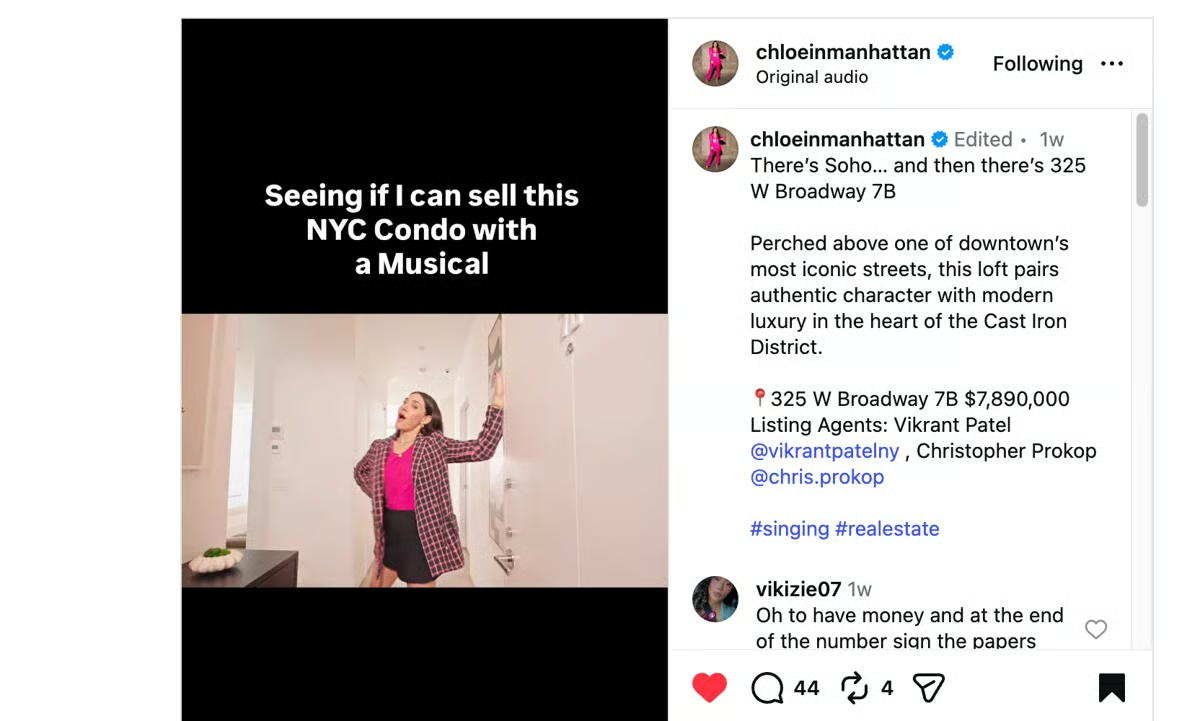
The lesson is not that every agent should sing through a listing tour. Tucker Caine’s approach works because it belongs to her. Another agent’s differentiator could come from cooking, architecture, comedy, fashion, fitness, finance, parenting, gardening, renovation, local history, or a previous career.
Ask yourself:
- What do people already associate with me?
- What could I discuss for hours without becoming bored?
- What did I do before real estate?
- What do my clients repeatedly ask for my opinion about?
- What part of my personality is missing from my marketing?
- What can I create that another agent could not reproduce convincingly?
Your differentiator does not have to appear in every post. It should be recognizable enough that someone can remember why your account feels different.
Create a recurring series followers can recognize
A recurring series gives your account familiar programming. Instead of inventing a new idea every time you post, you return to a premise that followers can recognize and you can continue producing.
A strong series includes:
- A clear topic
- A recognizable name
- A consistent opening or visual cue
- A repeatable structure
- A realistic publishing schedule
- Enough flexibility to produce multiple installments
For example, an agent could create a weekly neighborhood walkthrough, a series explaining what different budgets buy, a recurring inspection lesson, or a diary following the preparation of a listing. The individual topics can change while the basic format remains the same.
A series also allows an idea to build over time. Someone who discovers the seventh installment may visit your profile to watch the earlier videos. Followers who enjoy the premise understand what to expect when the next episode appears.
Before launching a series, brainstorm at least 10 possible installments. If you cannot develop more than two or three, the concept may work better as an individual post than an ongoing series.
Use Stories as the daily episode of your business
Your feed can feature your strongest, most intentional content, while Instagram Stories can capture the smaller moments that keep the business feeling current. Stories do not need the same level of production as a permanent post.
Use Stories to show where you are going, what you are working on, what you noticed in the market, or what happened during the day. A photograph from a showing, a quick video before an inspection, or a poll about a property feature can make followers feel included in the business.
Potential Story content includes:
- A preview of a new listing
- A behind-the-scenes look at photography
- A question from a buyer or seller
- A local business recommendation
- An interesting property feature
- A quick market observation
- A personal update
- A poll or question
- A repost from a client or community partner
- A reminder about an event or open house
Stories are also useful for starting conversations. Ask whether followers prefer one kitchen style over another, invite them to request information about a property, or encourage questions about a market change. These interactions give people an easier opening than sending an unsolicited message from scratch.
Do not turn every Story into a pitch. This format can build relationships because it feels immediate and conversational. Mix business updates with the personal and local moments followers might naturally discuss with you.
Turning Instagram activity into relationships
Connect before you concentrate on creating more content
One of Acree’s strongest recommendations was to use social media to be social. Many agents spend hours creating posts but little time responding to the people already interacting with them.
Before worrying about posting more, look for opportunities to participate in conversations. Reply to comments, respond when someone answers a poll, react thoughtfully to Stories, and engage with relevant local accounts. If someone consistently interacts with your content, acknowledge them instead of treating engagement like a number on a dashboard.
Ways to build connections include:
- Responding to every genuine comment
- Replying to local Stories
- Congratulating past clients on milestones
- Supporting local businesses
- Answering real estate questions in DMs
- Thanking people who share your posts
- Introducing yourself to new local followers
- Continuing conversations after an event
- Commenting with substance rather than emojis
- Sharing community posts with proper credit
A direct message does not need to become a sales presentation. If someone posts about moving, renovating, getting married, starting a business, or exploring a neighborhood, you can respond as a person first. If real estate becomes relevant, the conversation can develop naturally.
This strategy also changes what counts as a successful Instagram account. You do not need an enormous following to make meaningful connections. A smaller audience filled with people who know you, live in your market, and respond to your content can support a real business.
Build a sustainable Instagram routine
An Instagram strategy is only useful if you can maintain it while serving clients, prospecting, attending appointments, and managing transactions. A schedule that requires several hours of content creation every day will not work for most agents.
Begin with a cadence you can follow consistently. You might publish two or three strong feed posts each week, appear in Stories on most working days, and reserve a few minutes for genuine engagement. Increase the frequency only if the routine is producing useful conversations and remains manageable.
Here is one possible weekly schedule:
| Day | Content or activity |
|---|---|
| Monday | Publish an educational post |
| Tuesday | Engage with local accounts and respond to Stories |
| Wednesday | Share personal or behind-the-scenes content |
| Thursday | Publish the next installment of a recurring series |
| Friday | Share entertaining or community-focused content |
| Most days | Add informal Stories and respond to messages |
| Once a week | Plan, record, or schedule upcoming content |
This is an example, not an Instagram requirement. An agent who can publish twice a week consistently is in a better position than one who publishes every day for two weeks and then disappears.
Make the routine easier by documenting your existing work. Keep a running note of questions clients ask, lessons from transactions, local places you visit, and moments that could become content. Set aside time to record several videos or write multiple posts together when that suits your workflow.
Templates and scheduling tools can reduce production time, but they should support your personality rather than replace it. Acree summarizes the distinction well: Automate the marketing, not the relationship.
What real estate agents should not share on Instagram
Making an account more personal does not mean abandoning professional judgment. Real estate content can involve private information, occupied homes, financial decisions, and regulated advertising.
Avoid sharing:
- Lockbox codes, alarm details, or property security information
- Private client conversations
- Names or personal details without permission
- Contracts, emails, identification, or financial documents
- A client’s negotiating position
- Occupied-home details that create a safety risk
- Listing information you are not authorized to advertise
- Claims about a neighborhood or its residents that could create fair housing concerns
- Unverified claims about schools, safety, appreciation, or investment returns
- Content that violates brokerage, multiple listing service (MLS), copyright, or advertising rules
Review photographs and videos carefully before publishing them. Computer screens, paperwork, mail, family photographs, license plates, keys, and security systems can reveal more than you intended.
Agents should also establish personal boundaries. You can show your personality without publishing your location in real time, your children’s routines, your home address, or private family matters. Decide what remains off-limits before the pressure to post arises.
How to audit your real estate Instagram account
Review your profile as if you were a prospective client encountering it for the first time.
Ask:
- Can someone immediately tell that I am a real estate agent?
- Is my location or market clear?
- Does my bio explain whom I help?
- Is there an obvious next step?
- Do my recent posts show my expertise?
- Do they also show my personality?
- Is my content educational, entertaining, and relational?
- Am I appearing in my own content?
- Does the account show more than listings and closings?
- Do I have a recognizable point of view?
- Is there a recurring series or format?
- Am I responding to comments and messages?
- Does the account feel current?
- Can I realistically maintain this routine?
Then look at the overall impression created by your most recent posts. If nine of the last 12 are promotional graphics, the account probably feels more like a commercial than an account someone would choose to follow.
Do not respond by deleting everything or completely changing your identity. Add the missing elements gradually. Show more of the process, appear on camera, tell a personal story, or begin engaging more intentionally with local accounts.
Common Instagram marketing mistakes
Treating the account like a listing billboard
A listing shows you are active, but contact ads give non-moving followers little reason to stay. Show the story, decisions, and work behind the property instead of publishing only the announcement
Posting only when you want business
An agent who disappears for months and returns only to promote a listing has not built much familiarity. Maintain a realistic presence between transactions.
Copying another agent’s personality
You can learn from successful accounts without imitating their voice, jokes, personal style, or signature series. Use the strategy while creating a version that reflects you.
Trying to look perfect
Highly polished content can be useful, but a feed containing only perfect photographs and scripted videos may feel distant. Allow some everyday moments and honest lessons into the account.
Creating without engaging
Publishing more content will not automatically build relationships. Respond to the audience you already have and participate in your local Instagram community.
Chasing every trend
A trend should support your message or personality. Forcing unrelated audio, jokes, or formats into your content can make the account feel less consistent.
Making every call to action a sales pitch
Not every post needs to end with “Call me to buy or sell.” Invite followers to answer a question, share an opinion, save a resource, or send a low-pressure message.
Sharing private information
A behind-the-scenes strategy still requires consent, confidentiality, and safety. Inspect every frame before publishing content from a property or a transaction.
Starting too many recurring series
One recognizable series is more useful than five abandoned concepts. Stick with one format you can sustain and expand only when it becomes part of your routine.
Choosing an unrealistic posting schedule
Do not build your strategy around what a full-time creator publishes. Choose a cadence that leaves enough time to operate your real estate business and respond to the conversations your content creates.
Frequently asked questions (FAQs)
How should real estate agents use Instagram?
Real estate agents can use Instagram to demonstrate expertise, show properties, explain their work, highlight their communities, and develop relationships with prospective and past clients. The strongest strategies combine useful content with personality and genuine interaction.
Should real estate agents have separate personal and business Instagram accounts?
It depends on the agent’s preference and existing audience. Combining professional content with appropriate personal content can help followers get to know the person behind the business. Separate accounts may make more sense when the agent wants strict privacy or uses a personal profile primarily for close friends and family.
Do real estate agents need a large Instagram following?
No. A smaller audience of local homeowners, buyers, sellers, past clients, and community partners can be highly valuable. Relevance and relationships matter more than accumulating followers who have no connection to the agent’s market.
Your take
Instagram marketing for real estate agents does not require becoming a full-time influencer or turning every moment into content. It requires giving people a reason to recognize you, follow up, and feel comfortable starting a conversation.
Acree’s advice gets to the heart of the strategy: People want to connect with people, not transactions. Show your knowledge, but also show the work, personality, interests, and relationships behind it. Your account should remind followers that you are a capable real estate professional without feeling like one continuous advertisement/
Build a clear profile, choose the audience you want to serve, develop a recognizable point of view, and create a routine you can actually maintain. The goal is not to make your business look like a television show. It is to make your real estate career interesting enough that people want to keep watching.
Related Articles