






































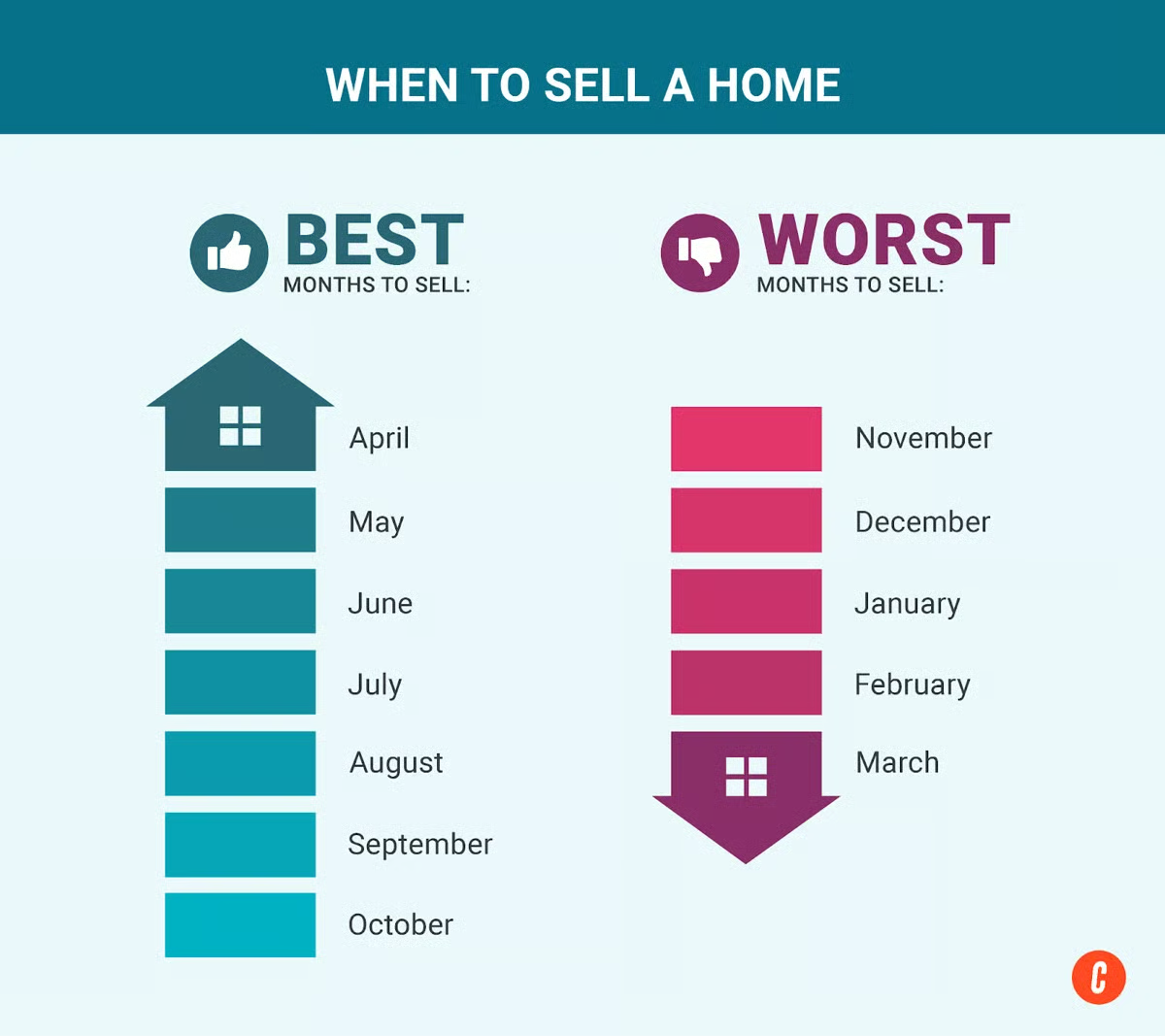
When is the best time to sell a house? Historically, late spring through early summer offers some of the strongest conditions for sellers, with May and June standing out for higher prices and faster sales. On the other hand, December and January tend to be the worst months to sell, when buyer activity slows and homes spend more time on the market.
But timing isn’t only about choosing the “best” month. Your ideal listing date depends on your goals, local market conditions, and whether you prioritize getting the highest price, selling quickly, or facing less competition. In this guide, I’ll break down the best and worst times to sell a house in 2026 and how sellers and agents can use seasonal trends to plan their strategy.
- What this means for sellers and agents
- Best time to sell a house at a glance
- Most profitable months to sell a house: May and June
- Least profitable months to sell a house: December and January
- Home sale data by month
- Pros & cons of selling a house in each season
- The best time to sell depends on your goal
- 2026 housing market update: What sellers should know now
- Frequently asked questions (FAQs)
- Bringing it all together
What this means for sellers and agents
Sellers:
If your goal is to sell quickly and maximize your profit, timing matters. Listing your home between April and October — especially in May or June — can lead to higher offers, faster sales, and even bidding wars. If you need to sell during the slower months, be prepared to price more competitively and spend more time on the market.
Agents:
Seasonality should shape your listing strategy, client conversations, and presentations. Use spring and early summer to push for higher pricing and shorter timelines, but set realistic expectations in the fall and winter. During slower months, focus on stronger marketing, pricing strategy, and pipeline building so you can stay productive year-round.
Best time to sell a house at a glance
There isn’t one perfect time to sell for every homeowner. The right timing depends on what you want to accomplish. Based on the seasonal trends covered in this guide, here’s where I would start:
| Your goal | Best time to consider selling |
| Get the highest sale price | May to June |
| Sell faster | May to July |
| Take advantage of higher buyer demand | Spring to early summer |
| Face less competition from other sellers | Winter |
| Avoid the historically slower selling period | December to January |
Most profitable months to sell a house: May and June
I recommend selling a house between April and October, as buyer demand outpaces the number of homes on the market, allowing homeowners to sell for higher prices. For the best timing, data shows that the most profitable and quickest sales tend to be in May and June.
During these months, homes are often sold for more than the listing price, and the median DOM is much lower. It’s a pretty consistent trend, so competition tends to get tough during this period. However, houses still sell quickly due to increased demand.
Read our article on the States With the Best & Worst Housing Markets to learn more.
Why May & June are the most profitable months to sell a house
The end of spring is a good time for homebuyers to be out and about, making it a prime time to look for a home. Because of this trend of rising demand, the market sees bidding wars, which are further fueled by the quick turnaround of properties.
Highest home prices
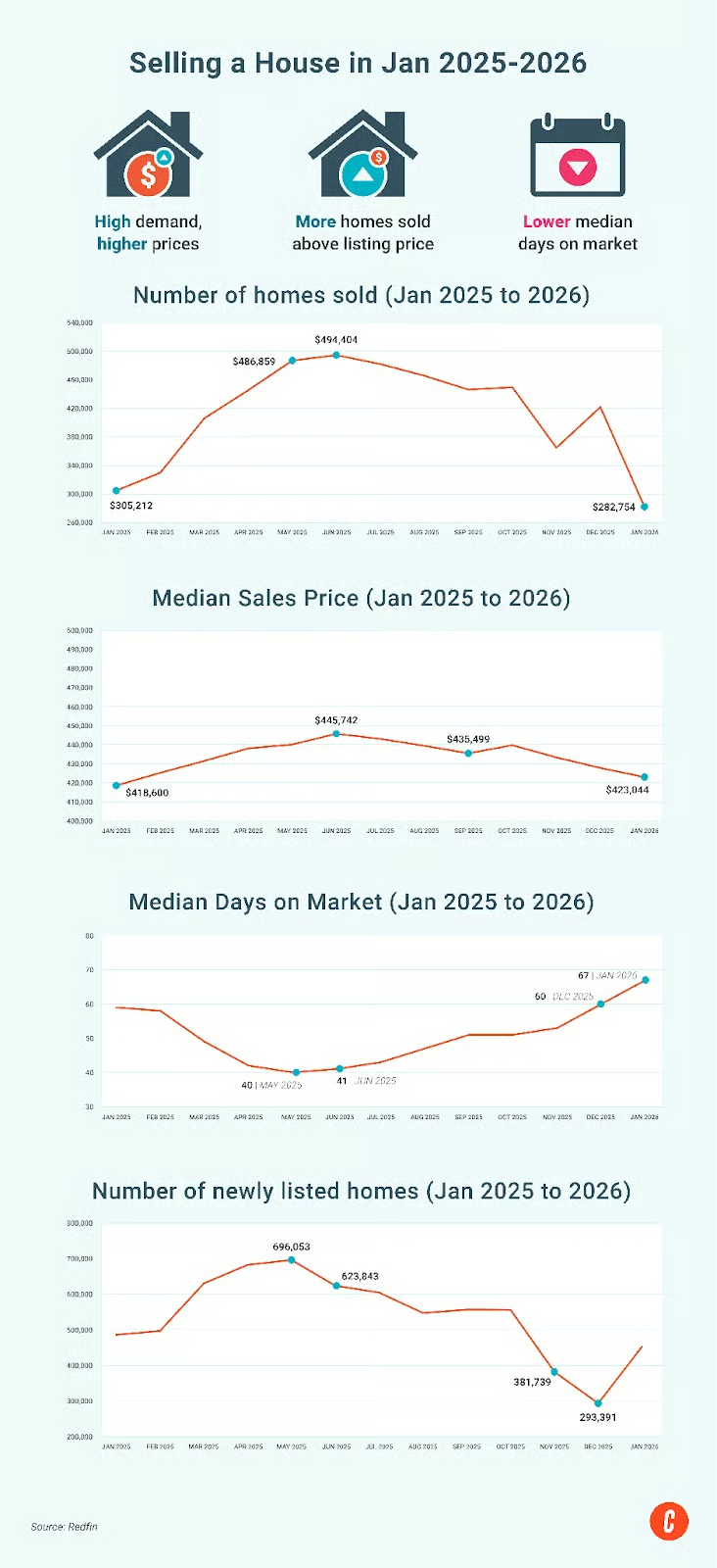
June is the best month to sell a house if you’re looking to maximize profit. High demand and low inventory drive up housing prices, allowing sellers to charge more for their properties. Data from the Federal Reserve Bank of St. Louis’ (FRED) show this trend, with median sale prices in June 2025 peaking at $432,700, followed by a sharp decline through January.
More homes sold above the list price
According to Redfin data, the percentage of homes sold above the list price peaked in June 2025 at about 31%. In the past five years, the percentage of homes being sold above the listing price typically peaks around May to June — so it’s a good idea to sell your home during this time span.
Lowest median DOM
DOM measures the average number of days properties remain on the market, so a low median indicates a seller’s market. The same data charts from Redfin show that May and June have the lowest median days (40 and 41 days, respectively, in 2025) — and the year-over-year data reflects the same trend, with May, June, and July having the lowest median DOM.
Least profitable months to sell a house: December and January
The worst period to sell a house is from November to March. Compared with the previous period, buyer demand is low, and there’s usually an oversupply. This leads to an extended DOM for most properties, often accompanied by price drops.
If you really need to sell, avoid December and January. Data shows that these months typically have the lowest prices and longest DOM for properties. Given that, I would recommend holding off at least until February if you’re not in a hurry.
Why December & January are the least profitable months to sell a house
December and January are typically when the cold weather peaks, and most homebuyers would prefer to stay indoors to spend quality time with their loved ones over the holidays. This lower demand increases the number of houses on the market, pushing prices down so listings can remain competitive.
On top of that, the average DOM goes up, which doesn’t just mean a longer wait for a home to sell. It also runs the risk of impacting its sellability. I often saw buyers avoid homes with longer days on market, assuming something must be wrong if the property has been sitting on the market.
Lower homebuyer demand
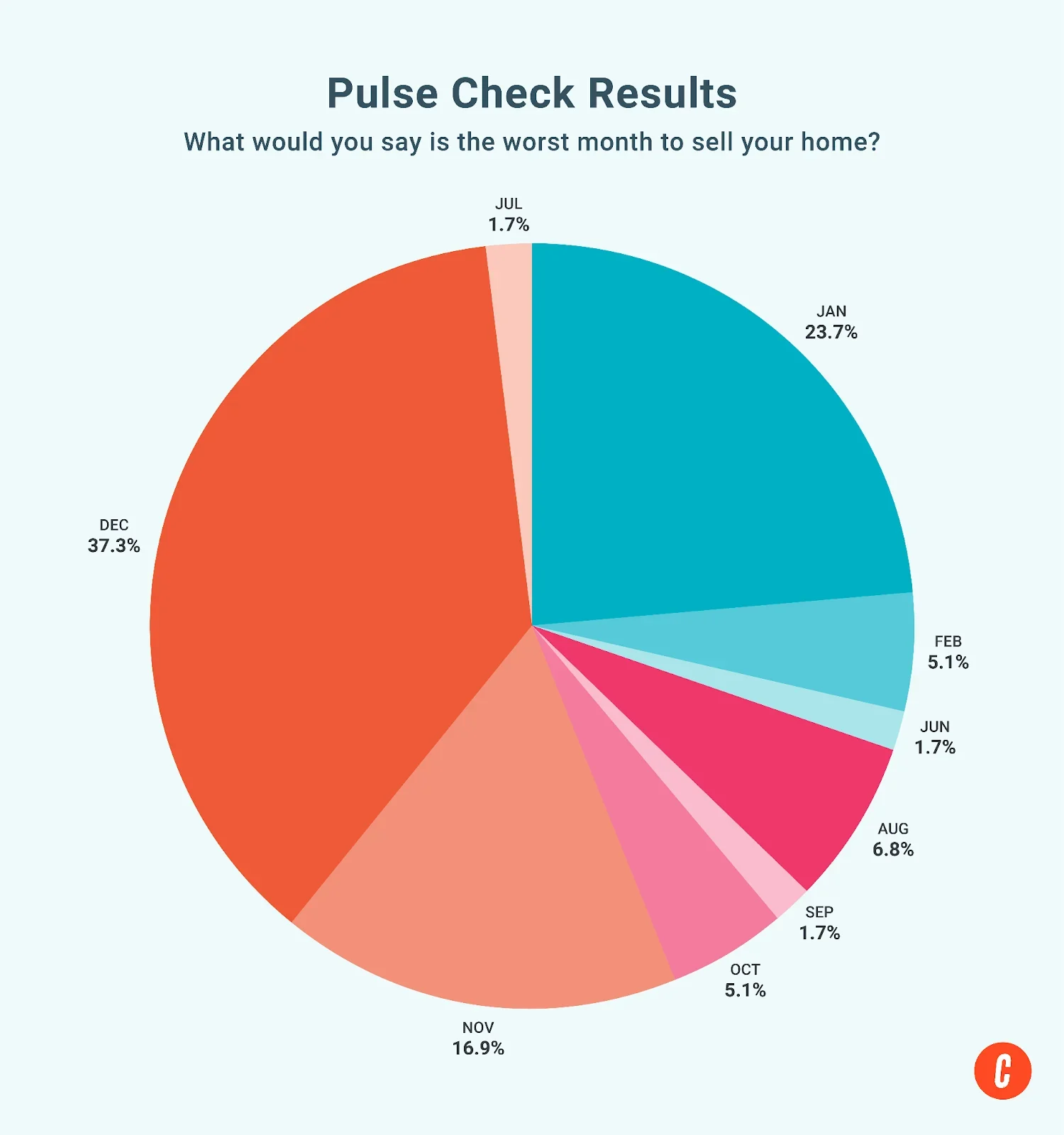
Historically, December and January are slow months for house sales. I recently polled over 100,000 agents who receive The Close newsletters, and the results are clear: the majority also agree that December and January are the worst months to sell a home. This is due to lower buyer demand due to holiday distractions, winter weather, and post-holiday financial constraints.
Lower home prices
The winter months are typically when home prices are lowest. The same sale price data listed above from FRED shows the lowest median in January 2025 at $393,400 — almost $40,000 lower than the median in May 2025.
Higher median DOM
If you want to sell your house quickly, January and February are the worst months to list. With a new year starting, work obligations picking up after the holidays, and continuing cold weather in most states, there is low urgency for real estate transactions. This results in longer DOM for homes listed during this time.
Long-term data from the above-mentioned Redfin dataset support this. In the past three years, either January or February has had the highest DOM. As of this writing, the data for February 2026 have not yet been released, but for January, the average DOM was 66, a sharp increase from previous months.
Home sale data by month
Based on the data, spring and summer are the best times to sell a house, as there are more homebuyers following the holiday season. That causes home prices to rise, more homes to sell above their listing prices, and bidding wars to break out. On the other hand, the colder months, fall and winter, are the worst times to sell a house. That’s because home sale prices are lower, median DOM is higher, and price reductions are more significant.
| Housing market trends from January 2025 to January 2026 | |||||
|---|---|---|---|---|---|
| Month | Number of newly listed homes | Number of homes sold | Median sale price of homes | Median DOM | |
| Best months to sell a house | May 2025 | 695,827 | 486,813 | $440,124 | 40 |
| June 2025 | 623,694 | 494,419 | $445,821 | 41 | |
| July 2025 | 604,357 | 481,900 | $443,080 | 43 | |
| August 2025 | 586,856 | 465,635 | $439,425 | 47 | |
| September 2025 | 551,819 | 446,199 | $453,485 | 51 | |
| October 2025 | 554,689 | 449,515 | $439,757 | 51 | |
| Worst months to sell a house | November 2025 | 380,493 | 380,493 | $433,231 | 53 |
| December 2025 | 291,421 | 421,578 | $427,787 | 60 | |
| January 2025 | 485,757 | 305,222 | $418,580 | 59 | |
| February 2025 | 496,819 | 330,312 | $425,282 | 57 | |
| January 2026 | 449,251 | 281,925 | $423,029 | 66 | |
| Sources: Source: Redfin | |||||
Pros & cons of selling a house in each season
Different months of the year, from winter to summer, often present less-than-optimal selling conditions. When considering selling a property, keep the following general tips in mind, as well as the pros and cons of selling a home in each season.
| Season | Pros | Cons |
|---|---|---|
| Winter (December to March) |
|
|
| Spring (March to June) |
|
|
| Summer (June to September) |
|
|
| Fall (September to December) |
|
|
The best time to sell depends on your goal
May and June may look strongest on paper, but getting the highest possible sale price isn’t usually a seller’s only priority. Your timeline should account for how quickly you need to move, how much competition you’re facing, and what’s happening in your local market.
- If you want the highest possible price: Late spring and early summer are a strong place to start. Higher buyer activity can create more competition for desirable properties.
- If you want to sell quickly: Pay attention to periods when buyer demand increases and median days on market decline. Based on the data in this article, May through July historically offers favorable conditions.
- If you want less seller competition: Winter can have an advantage. There may be fewer buyers, but there are also typically fewer sellers competing for their attention.
- If you need to move now: I wouldn’t delay an important move solely because another month historically performs better. Interest rates, inventory, local demand, your home’s condition, and your personal circumstances can outweigh national seasonal trends.
Think of seasonality as one piece of your pricing and listing strategy, not the entire strategy. A well-priced home in a strong local market can still perform well outside the traditional spring selling season.
2026 housing market update: What sellers should know now
More than halfway through 2026, the housing market has become increasingly balanced, giving buyers more options while making pricing and timing more important for sellers. Inventory has increased, but elevated mortgage rates continue to limit affordability and buyer demand in many markets. Realtor.com found that the second quarter of 2026 was the most buyer-friendly quarter in its data, dating back to 2018.
That doesn’t mean sellers have lost their advantage everywhere. Redfin reported that the median US home sale price reached a record high in June, while existing-home sales reached their highest level since 2022. However, conditions vary significantly by market, and rising mortgage rates have recently slowed buyer demand.
For sellers thinking about listing during the remainder of 2026, pricing correctly and understanding your local market may matter even more than waiting for a traditionally favorable month.
| 2026 market update | Source | What it means for sellers | What it means for agents |
| Home prices are now expected to rise just 1.2% in 2026. | Realtor.com | Don’t assume waiting will result in significant price appreciation. | Accurate pricing and local comps are increasingly important. |
| Inventory continues to rise, giving buyers more choices. | Realtor.com | Sellers may face more competition and negotiation. | Listings need stronger pricing, presentation, and marketing strategies. |
| Home values are expected to remain roughly flat for 2026. | Zillow | Waiting solely for higher prices may not pay off. | Help sellers evaluate their local market rather than relying on national appreciation rates. |
| Elevated mortgage rates are limiting buyer demand. | Redfin | Fewer buyers may be willing or able to stretch their budgets. | Set realistic expectations around offers, concessions, and DOM. |
Realtor.com cut its 2026 home-price-growth forecast to 1.2% and expects existing-home sales to increase just 1% from 2025. Zillow’s outlook is even more subdued, forecasting essentially flat home values and limited sales growth as elevated mortgage rates and increasing inventory weigh on the market.
What does this mean if you’re selling in the second half of 2026?
The second half of 2026 may require sellers to be more strategic than they were during the peak spring selling season. More inventory gives buyers additional choices, while mortgage rates continue to put pressure on affordability. In July, Realtor.com reported that active inventory remained above 1.1 million homes for five consecutive weeks, the longest stretch since 2019.
For sellers, that makes competitive pricing, strong presentation, and local market conditions increasingly important. Rather than waiting for a specific month to list, look at how quickly comparable homes are selling, how much inventory is available, whether sellers are making price reductions, and how much negotiating power buyers have in your area.
Frequently asked questions (FAQs)
Do interest rates affect when I should sell my home?
Yes, interest rates can influence the best time to sell a home. Interest rates directly affect buyer affordability and demand. When rates are lower, buyers can typically afford higher home prices and monthly payments, which can increase competition and lead to stronger offers. When rates rise, some buyers may pause their home search, which can slow demand. However, interest rates are just one factor. It’s important to understand local inventory, job growth, and seasonal trends, which can also impact the success of a home sale.
How does inventory impact the best time to sell?
Housing inventory plays a major role in determining the best time to sell a home. Inventory affects the level of competition in the market. When inventory is low and fewer homes are listed for sale, sellers typically face less competition and may receive stronger offers from buyers because buyers have fewer options. When inventory is high, buyers have more choices, which can make it harder to stand out and may lead to longer days on the market. It’s important to monitor local inventory levels when deciding to list a home.
Does staging help sell a home regardless of the season?
Yes, staging can help sell a home regardless of the season. Staging helps make a property more appealing and easier for buyers to visualize themselves living there. Well-staged homes often appear more polished in listing photos and during showings, which can attract more interest and potentially lead to stronger offers. Staging can vary by season — during the warmer months, exterior areas may also need staging, including pool decks, porches, and backyards.
Bringing it all together
If you’re looking to sell a property, remember that timing is everything. The best and worst months to sell a house depend on seasonal trends that could affect the home sale price.
According to real estate statistics, it’s best to sell a house during spring to late summer, or from April to October. Since demand outweighs supply, housing prices are higher, and homes sell faster. Meanwhile, the worst months to sell a house are November through March or during the fall to winter, when potential buyers are preoccupied with holiday plans. Sellers should expect lower sales prices and higher DOM during these months.
Related Articles