
































Getting your Florida real estate license starts with a manageable checklist: complete your education, apply to the state, submit fingerprints, pass the exam, and activate your license with a brokerage. The confusing part is knowing which steps overlap, what you’ll actually pay, and what happens after you pass.
As a licensed real estate agent, I know how easy it is to focus on the exam and overlook the decisions that come next. Choosing a school that fits your schedule matters, but so does finding a brokerage that will help you learn the business. Here’s how to become a real estate agent in Florida, with the requirements, costs, and practical details to help you plan.
- Quick facts and costs for a Florida real estate license
- Step 1: Meet Florida’s real estate license requirements
- Step 2: Complete a Florida-approved 63-hour prelicensing course
- Step 3: Apply for your Florida real estate license
- Step 4: Submit fingerprints for your background check
- Step 5: Pass the Florida real estate sales associate exam
- Step 6: Choose a brokerage and activate your license
- Step 7: Start building your business and plan your first renewal
- Why I recommend Casa Academy
- Your take
Quick facts and costs for a Florida real estate license
Florida’s entry-level real estate license is called a sales associate license. Here’s the standard path for a first-time applicant.
| Step | What you need to do | Cost |
| Confirm your age, education, and Social Security number | No cost |
| Finish the required course and pass the course exam | Casa Academy: $199 |
| Submit your application through DBPR | Confirm current application fee |
| Schedule fingerprinting with an approved Live Scan provider | Varies by provider |
| Schedule through Pearson VUE and pass the exam | Confirm current exam fee |
| Compare brokerages and activate your license with your employing broker | Brokerage costs vary |
| Establish your business routines and complete 45-hour post-licensing education before your first renewal | Casa Academy: $49; state renewal fee and business expenses separate |
Why you can trust The Close
As a licensed real estate agent, I know getting licensed takes more than completing a course. You’re fitting study time around your life, budgeting for expenses, and deciding where to begin your career. I approach licensing guides with those practical concerns in mind, including the questions I would want answered before enrolling or submitting an application.
For this guide, I reviewed Florida DBPR requirements, Pearson VUE testing information, and Casa Academy’s published course details. My personal perspective comes from becoming and working as an agent, while Florida-specific licensing instructions come from the agencies responsible for those requirements. That helps keep the advice practical without confusing personal experience with state rules.

Step 1: Meet Florida’s real estate license requirements
Before paying for a course, confirm that you meet the basic requirements. Florida sales associate applicants must be:
- At least 18 years old
- Have a high school diploma or its equivalent
- Have a US Social Security number
Step 2: Complete a Florida-approved 63-hour prelicensing course
Applicants must complete a 63-hour sales associate prelicensing course before taking the state exam. You can choose an approved online course or classroom instruction.
The course introduces the legal and business concepts you’ll need for the exam, including license law, brokerage relationships, contracts, property ownership, financing, and real estate calculations. Your course-completion certificate remains valid for two years.
Certain applicants qualify for an education exemption. For example, active Florida Bar members in good standing and applicants with a qualifying four-year or higher degree in real estate may be exempt from the prelicensing course. Check DBPR’s requirements to see if you qualify for an exemption.
Florida real estate education through Casa Academy
Casa Academy offers an online option for completing Florida’s required prelicensing education. Its self-paced prelicensing course includes English and Spanish options and exam preparation.
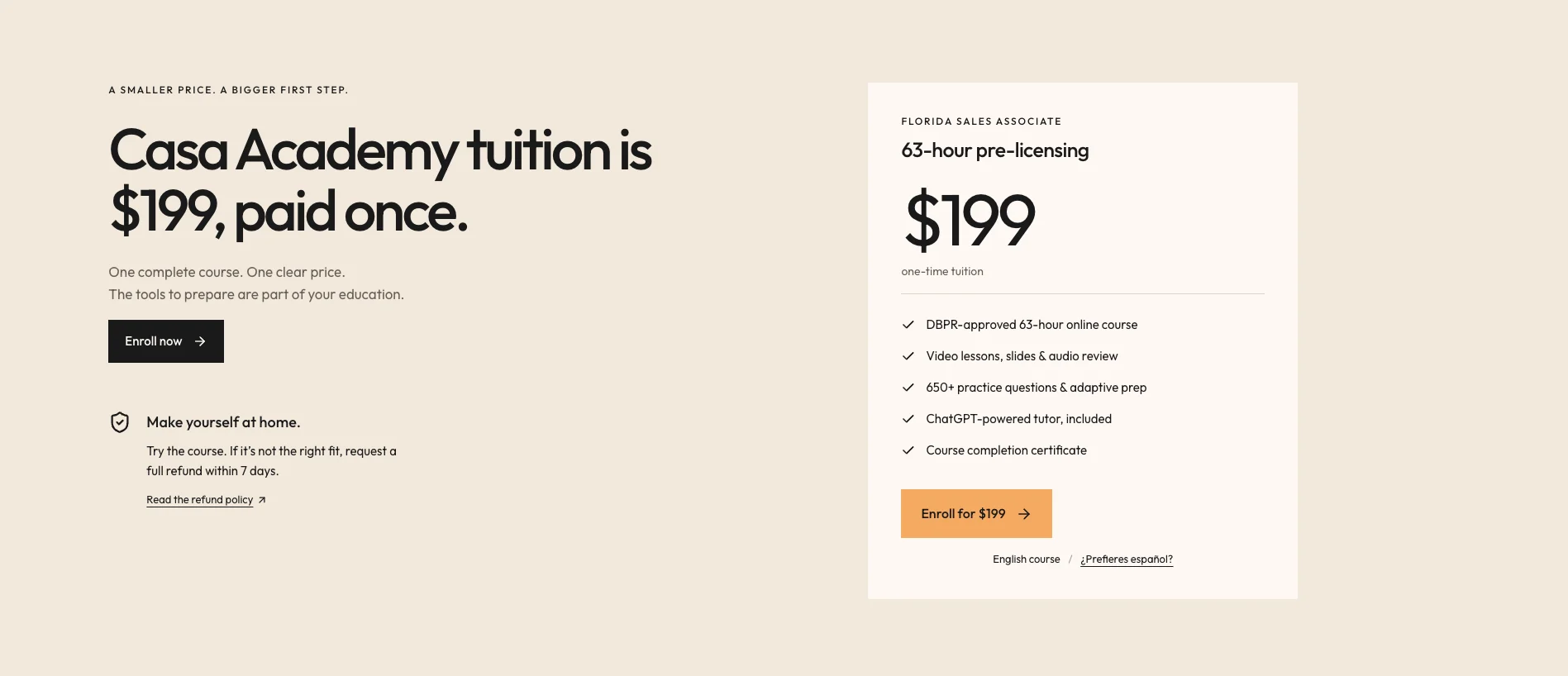
| Casa Academy course | Price | When you need it |
| Sales associate prelicensing | $199 | Before taking the state licensing exam |
| Exam preparation | Included with prelicensing | While preparing for the state exam |
| 45-hour sales associate post-licensing | $49 | Before your first license renewal |
| 14-hour continuing education | $49 | For subsequent renewal cycles |
Step 3: Apply for your Florida real estate license
Submit the Sales Associate Initial Application through DBPR. You can apply before finishing your prelicensing course, so you can overlap application processing with coursework. Be prepared to provide your identifying information, education information, professional licensing history, and a response to background questions.
Related articles
How to Choose a Real Estate Broker as a New Agent
Online Real Estate Brokerages: Is Virtual the Way to Go?
5 Best Real Estate Continuing Education Providers
14 Real Estate Agent Tips for Newbies to Guarantee Success
Step 4: Submit fingerprints for your background check
Arrange fingerprinting through a Live Scan provider registered with the Florida Department of Law Enforcement.
Fingerprinting prices vary by provider, so request the full price before booking. DBPR says results may take up to five days to reach the department after submission to FDLE; that is separate from the time needed to review your overall application.
Step 5: Pass the Florida real estate sales associate exam
Once DBPR approves your application, follow the authorization instructions to schedule your exam with Pearson VUE.
| Exam detail | Florida sales associate requirement |
| Testing provider | Pearson VUE |
| Format | 100 multiple-choice questions |
| Standard testing time | 3½ hours |
| Passing score | 75 points out of 100 |
| Published exam fee | $36.75; confirm when booking |
| Scheduling | After application approval |
| Testing location | Physical Pearson VUE testing center |
Before test day, review the current identification and admission instructions. Plan to bring:
- Two acceptable forms of signature identification, including the required government-issued identification.
- Your valid prelicensing course-completion certificate or applicable exemption documentation.
- Your authorization information.
- An allowed calculator.
Step 6: Choose a brokerage and activate your license
Passing the exam is a major accomplishment, but it doesn't automatically activate your license. For the typical brokerage path, you must register with an employing broker before performing licensed real estate services.
As an agent, I would give this decision as much attention as choosing a school. A commission split tells you what you might keep from a closing, but it does not explain who will help you write your first offer or answer a question during negotiations.
When interviewing brokerages, compare:
- Training: What does the first month look like for a new agent?
- Broker access: Who answers transaction questions, and when are they available?
- Mentorship: Is there a mentor, and does that arrangement have an additional fee?
- Costs: What are the commission split, transaction charges, recurring fees, and required tools?
- Business development: Will you receive practical help with prospecting, consultations, and follow-up?
- Expectations: Are there production requirements, office commitments, or team obligations?
For more information on comparing your options, read our guide on the best real estate companies to work for.
Step 7: Start building your business and plan your first renewal
Once your license is active, start building routines you can repeat. Learn your brokerage’s transaction process, organize your contacts, practice buyer and seller consultations, and set aside time for follow-up.
I would focus on learning how to serve clients before buying every marketing tool available. A consistent prospecting schedule and access to someone who can review your work can be more useful than a collection of subscriptions you have not learned to use.
Complete your first-renewal education
Florida sales associates generally must complete 45 hours of approved post-licensing education before their initial license expiration date, whether the license is active or inactive. Check the date shown on your license instead of assuming you have exactly two years.
For subsequent renewals, the standard education requirement is 14 hours every two years, consisting of:
- Three hours of Core Law.
- Three hours of Business Ethics Practices.
- Eight hours of specialty education.
Why I recommend Casa Academy
As an agent, I appreciate a course that gives you flexibility without leaving you to figure everything out alone. Casa Academy’s self-paced format lets you fit lessons around work and family, while full English and Spanish course options let you study in the language you’re most comfortable with. Included exam prep also means you can review and practice without buying a separate package.
The AI tutor is another feature that stands out to me. Available within each lesson, it gives you a way to ask questions and get additional explanations when a concept isn’t clicking, even if you’re studying outside typical classroom hours. Combined with practice questions, timed practice exams, and flashcards, those tools give you several ways to work through the material. I would use them to understand why an answer is correct, rather than simply memorize it.
Frequently asked questions (FAQs)
How long does it take to become a real estate agent in Florida?
Your timeline depends on your study schedule, application review, fingerprint processing, and exam availability. You must complete the required 63-hour course unless you're exempt, but you can submit your application while you are still studying. Plan for the full process, rather than assuming course completion means you can start working immediately.
What happens if I fail the Florida real estate exam?
Pearson VUE’s published fact sheet says candidates must wait 24 hours before scheduling another attempt. You will need to pay for the next exam and meet the applicable eligibility requirements. Your course certificate must still be valid when you return to test.
Does a Florida real estate license guarantee an income?
No. A license allows you to pursue work within its permitted scope, but it does not supply clients or guarantee closings. When planning your career, budget for business expenses and the time it may take to develop a pipeline.
Your take
Becoming a real estate agent in Florida is easier to manage when you take it one step at a time. If you’re ready to begin, Casa Academy is worth considering for your coursework. From there, keep track of your application, testing requirements, and renewal deadlines so you can stay focused on what comes next.
As an agent, my biggest advice is to think beyond passing the exam. Choose a brokerage where you can ask questions, practice, and build confidence. Your license gets you started; the habits and support you develop afterward help you turn that opportunity into a business.
You may also like…
7 Best Online Real Estate Schools in Florida (FL) for 2026
Gold Coast Real Estate School vs Casa Academy
The Ultimate Agent Script Pack: 15 Scripts for Any Lead, Any Time