





































Commercial real estate in 2026 is being reshaped by how people live, work, and spend. From empty buildings and reimaged malls to the rapid rise of data centers and EV infrastructure, demand is shifting across every sector. Whether you’re a commercial real estate agent or an investor, understanding these changes is key to identifying opportunities and staying competitive. In this guide, I break down 10 commercial real estate trends shaping the 2026 commercial real estate outlook.
- What these trends mean for the 2026 commercial real estate outlook
- 1. Office-to-residential conversions
- 2. Data center growth
- 3. Reimaging malls
- 4. Life sciences real estate stabilizes
- 5. The self-storage market is shifting
- 6. Ecommerce is reshaping real estate
- 7. Quick-service restaurants expansion
- 8. Hospitality real estate enters a new investment cycle
- 9. EV charging infrastructure
- 10. Aging America fuels growth in senior housing
- Frequently asked questions (FAQs)
- Bringing it all together
What these trends mean for the 2026 commercial real estate outlook
| Commercial real estate trend | Effect on the market |
| Office-to-residential conversions | • Reduces excess office supply • Helps address urban housing shortages |
| Data center growth | •Increases demand for power and land • Expands development in tech and secondary markets |
| Reimaging malls | • Shifts retail to mixed-use destinations • Adds housing, dining, and entertainment |
| Life sciences real estate stabilizes | • Moves toward balanced growth • Increase preleased, build-to-suit development |
| The self-storage market is shifting | • Slows rent growth • Encourages more cautious investment strategies |
| Ecommerce is reshaping real estate | • Drives warehouse demand • Expands last-mile and urban logistics |
| Quick-service restaurants expansion | • Boosts demand for high-traffic retail • Prioritizes drive-thru and takeout locations |
| Hospitality real estate enters a new investment cycle | • Creates discounted buying opportunities • Signals early recovery in the sector |
| EV charging infrastructure | • Becomes a required amenity • Adds long-term value to properties |
| Aging America fuels growth in senior housing | • Increases demand for senior living • Expands healthcare real estate |
1. Office-to-residential conversions
Across the United States, aging office buildings sit empty, and owners are increasingly converting them into residential units as demand for traditional office space continues to decline. Companies moving away from the five-day office workweek, accelerated by the COVID-19 pandemic, have changed how office space is viewed and how downtown areas function. Hybrid or virtual offices are becoming a permanent part of many industries, and cities are grappling with growing inventories of underused office buildings.At the same time, the US is facing a severe housing shortage, creating an opportunity for adaptive reuse. Converting underutilized office buildings into apartments allows cities to address two challenges at once, reducing excess office supply while adding much-needed housing in urban areas. An example of a major conversion is Manhattan’s 25 Water Street, which was reworked into 1,300 apartments.
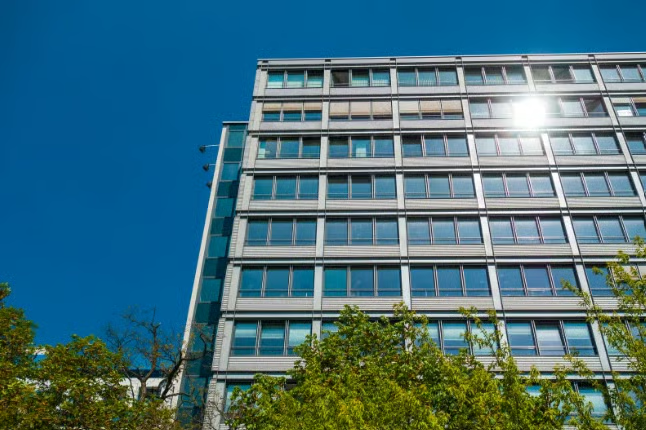
Conversions are not always simple. Office buildings may not be designed for residential use, and projects can be slowed by zoning restrictions, financing challenges, and building design limitations. As a result, while office-to-residential conversions are a visible trend, they remain a complex redevelopment strategy requiring careful planning and local government support.
Investor and agent takeaway:
Older office buildings, especially Class B and Class C properties in city centers, may increasingly be evaluated for redevelopment potential rather than long-term office use. Commercial investors and agents who understand local zoning rules and housing demand will be well-positioned to identify opportunities as more cities explore office-to-residential conversion projects.
2. Data center growth
Data centers are rapidly emerging as one of the fastest-growing sectors in US commercial real estate, fueled by the explosion of cloud computing, artificial intelligence, and digital infrastructure. As businesses and consumers generate more data and rely increasingly on AI-powered tools, demand for large-scale data processing facilities has surged across the country.According to CBRE’s North American Data Center Trends report, vacancy rates in primary US data center markets fell to a record low of just 1.4%, reflecting extremely strong demand and limited available supply. Leasing activity has accelerated as hyperscale technology companies expand capacity, driving record absorption levels and significant new development across major markets such as Northern Virginia, Dallas-Fort Worth, Phoenix, and Silicon Valley.

The surge in AI and cloud infrastructure is also driving up prices. Data center space average asking rates increased 6.5% year-over-year, while competition for large facilities with scalable power capacity continues to intensify. Development does face challenges, including power availability, zoning approvals, and permitting timelines, which can slow new projects even as demand continues to grow.
Investor and agent takeaway:
AI and cloud computing are continuing to expand, and demand for data center infrastructure is expected to remain strong. Investors and agents who understand emerging data center markets — particularly in regions with available power, fiber connectivity, and development incentives — may find growing opportunities as this niche CRE sector continues to scale.
3. Reimaging malls
Retail real estate across the United States is undergoing a transformation as developers rethink the future of traditional shopping malls. For decades, malls served as central gathering places for shopping, dining, and entertainment. But, how many shoppers today have walked through a once-busy mall only to find empty storefronts and quiet food courts? I sure have. The rise of ecommerce and changing consumer behavior has significantly reduced foot traffic in many malls.
Instead of abandoning these malls, developers are reinventing them through mixed-use redevelopment. Moving away from functioning solely as retail centers, many malls are being redesigned to include housing, offices, dining, entertainment, and public spaces. These new mixed-use spaces aim to create vibrant destinations where people can live, work, and socialize—helping retail centers remain relevant in an era when shopping alone is no longer enough to draw consistent foot traffic to a mall.

Major redevelopment projects are already underway across the country. This year, Simon Property Group announced $250 million in renovation plans for several prominent malls, including The Mall at Green Hills in Nashville, Cherry Creek Shopping Center in Denver, and International Plaza in Tampa. These plans include modernization of storefronts, adding luxury retail and dining experiences, and introducing walkable outdoor spaces. In other cases, malls have been repurposed into warehouse space or even into a high school.
Investor and agent takeaway:
Traditional malls may no longer function as retail-only properties, but their large footprints and prime locations make them valuable redevelopment opportunities. Investors and agents look for aging retail centers that can support mixed-use projects, particularly in growing metros, where adding residential, entertainment, or office space could significantly increase property values.
4. Life sciences real estate stabilizes
After several years of rapid expansion, the US life sciences real estate sector is entering a more balanced phase of growth. Life sciences real estate refers to specialized commercial properties designed for biotechnology, pharmaceutical, and scientific research activities, including laboratory, research, and development facilities. Demand for these highly specialized spaces surged during the biotech boom earlier in the decade, leading to a wave of new development across major innovation hubs.
Vacancy rates for properties designated for life sciences have begun to stabilize while development activity has dropped sharply from its recent peak. Even with stabilization, rents remain significantly higher than those for traditional office space, averaging about $66 per square foot nationally and commanding roughly 40% higher rents than standard office buildings. This pricing premium is due to the specialized infrastructure required for lab and research space.

New development has also become much more disciplined. The construction pipeline has shrunk drastically from its 2023 peak, with only about 8 million square feet currently under development, the lowest level since 2019. Instead of building and then trying to find a renter, many of these new developments are already preleased, signaling a shift toward build-to-suit developments that reduce speculative risk and align new supply more closely with tenant demand.
Investor and agent takeaway:
Life sciences real estate remains one of the most specialized and resilient commercial real estate sectors. Investors and agents should focus on major biotech hubs, such as Boston, San Diego, and the San Francisco Bay Area, where research activity, talent pools, and venture funding continue to support long-term demand for laboratory space.
5. The self-storage market is shifting
The US self-storage sector is cautious as the rest of the market works through slower demand and softer rent growth. After several years of strong performance during the pandemic, when moving activity and household transitions drove storage demand, the sector is now adjusting to shifting housing conditions and lower home sales.
According to a National Self Storage Report by Yardi Matrix, storage rents rose slightly, 0.3%, signaling modest growth but at a slower pace than previously. Demand for self-storage remains uneven across markets, with stronger performance in metro areas such as New York City, Boston, and Washington D.C., where population growth and rising multifamily rents continue to support storage demand.

Industry analytics expect uneven growth this year, particularly in markets with higher supply levels. However, investor interest remains steady, with debt and equity capital still available for experienced operators. Investors are approaching new self-storage acquisitions cautiously, adjusting underwriting assumptions around rent growth and lease-up timelines as the market stabilizes.
Investor and agent takeaway:
Self-storage remains a resilient niche within commercial real estate, but investors are shifting toward more conservative strategies in the near term. Agents and investors should watch markets with strong population growth and limited new supply, where storage demand may recover faster as housing conditions improve.
6. Ecommerce is reshaping real estate
Ecommerce’s continued growth is transforming how commercial real estate supports retail and logistics across the United States. Online shopping is now embedded in everyday life, and retailers and logistics companies are racing to secure warehouses and fulfillment centers near consumers. Industry research suggests that ecommerce tenants could account for nearly one quarter of all new US warehouse leasing in 2026. This reflects how digital retail has become a structural driver of demand for industrial real estate.
Unlike traditional retail, online commerce requires significantly more logistics infrastructure. Studies show that ecommerce sales require roughly three times as much distribution space as in-store retail, largely due to increased inventory assortments, higher product returns, and the need to store goods closer to customers for rapid delivery. Every 1% increase in ecommerce’s share of retail spending can generate demand for 50 to 70 million square feet of additional warehouse space.

The industry is evolving beyond large suburban warehouses; instead, retailers are increasingly adopting micro-fulfillment centers and last-mile facilities located in dense urban areas to speed up delivery times and improve efficiency. These compact automated facilities rely on robotics and AI-driven inventory systems to process online orders quickly, helping retailers support same-day and next-day delivery expectations. As consumer demand for fast shipping continues to grow, these urban logistics are becoming a critical part of the modern supply chain.
Investor and agent takeaway:
Ecommerce is permanently increasing demand for logistics and distribution real estate. Investors and agents should focus on properties positioned for last-mile delivery — particularly warehouses near major population centers or transportation hubs — where proximity to consumers can significantly increase property value and tenant demand.
7. Quick-service restaurants expansion
The restaurant industry is expected to see continued growth this year, with consumer demand for dining out remaining strong despite ongoing economic pressures. According to the National Restaurant Association’s 2026 State of Restaurant Industry Report, US restaurant sales are projected to reach $1.55 trillion nationwide, reflecting steady growth as consumers return to restaurants when budgets allow.
Within the industry, quick-service restaurants, such as fast-food and fast-casual chains, are playing a major role in shaping commercial real estate demand. Quick-service restaurants prioritize speed, convenience, and affordability, focusing on locations to capture consumer spending even as household budgets tighten. Many operators are expanding their footprints, particularly in high-traffic retail corridors, suburban areas, and mixed-use developments.

The demand for quick-service restaurants is influencing how restaurant real estate is designed and where new locations are built. These brands are increasingly seeking properties that support drive-thru lanes, easy vehicle access, and strong roadside visibility to accommodate high volumes of takeout and mobile orders. As a result, developers are incorporating more restaurant pad sites into shopping centers and mixed-use projects, recognizing that quick-service restaurants can drive consistent foot traffic and strengthen overall property performance.
Investor and agent takeaway:
Quick-service restaurants remain one of the most reliable retail tenant categories, even during uncertain economic conditions. Investors and agents should pay close attention to retail centers that attract strong restaurant tenants, as these brands often offer stable leases and consistent customer traffic that support surrounding businesses.
8. Hospitality real estate enters a new investment cycle
The hospitality sector, including hotels, motels, and related real estate, is in a transitional moment. After several years of limited transactions and market uncertainty, investor interest is beginning to return as pricing resets and travel demand stabilize. Though hotel performance metrics, such as revenue per available room and average daily rate, have been slightly below projections in recent months, industry analysts say the sector is moving toward a gradual recovery.
For commercial real estate investors, the most significant shift is happening in pricing and transaction activity. According to Crezi, hotel capacity rates have risen sharply as buyers demand higher returns, while some properties are trading at substantial discounts to pre-pandemic values. Right now, there are great opportunities for investors seeking hospitality-focused real estate at a discount. Limited-service hotels that cost around $150,000 per room to build a few years ago are now trading at $75,000 to $90,000 per room.

The hospitality sector is also becoming increasingly segmented. Luxury hotels and high-end destinations continue to perform relatively well, while midscale and economy properties face greater challenges and operational pressure due to higher costs and softer demand. Construction of new hotels has also slowed significantly due to high financing costs, which may help stabilize supply over the next several years. As distressed assets enter the market and development pipelines shrink, investors are increasingly looking more closely at repositioning opportunities and value-add strategies.
Investor and agent takeaway:
Hospitality real estate is entering a phase where pricing resets may create opportunities for patient investors. Agents and investors should watch for distressed or discounted hotel assets, particularly in strong travel markets or urban centers, where repositioning, renovation, or operational improvements could unlock long-term value. As activity picks up, this shift can also create new opportunities to generate leads, especially when working with investors looking to enter or expand in the hospitality space.
9. EV charging infrastructure
Electric vehicle (EV) adoption is accelerating across the United States, and real estate is beginning to adapt to support the shift. Automakers are expected to launch more than 30 new electric vehicle models this year, expanding consumer choice across price points and vehicle categories. The rise of EV ownership is increasing, creating the demand for convenient charging access, which is rising quickly–particularly at homes, workplaces, hotels, and retail destinations where vehicles are parked for extended periods.
The rise of EV ownership is now influencing real estate development and property design. In California, new building codes that took effect in 2026 require EV-ready infrastructure in most new residential developments, with at least one EV-ready parking space per unit in many multifamily properties. These requirements extend beyond residential housing and into commercial spaces. New hotels must now provide EV-ready infrastructure in at least 65% of parking spaces, reflecting expectations that travelers will increasingly arrive in electric vehicles.

For commercial real estate owners, EV charging infrastructure is emerging as both a compliance requirement and a competitive amenity. Properties that offer charging stations can attract tenants, customers, and guests who rely on convenient access to charging. Charging stations are also becoming more technologically advanced, with smart chargers connected to mobile apps and cloud-based systems that allow property owners to manage usage, optimize energy consumption, and potentially generate additional revenue through charging fees or partnerships with utilities.
Investor and agent takeaway:
EV charging infrastructure is quickly becoming part of modern building design and property amenities. Investors, developers, and agents should monitor how EV adoption is influencing parking requirements, tenant expectations, and property upgrades. Pay particular attention to multifamily housing, hospitality, retail centers, and mixed-use developments where convenient charging access can add long-term value.
10. Aging America fuels growth in senior housing
Demographic change is one of the most powerful long-term drivers of commercial real estate. The US population aged 75 and older is growing by more than one million people each year, roughly three times the pace seen over the past four decades. Americans are living longer and require more healthcare services. Demand for senior housing, assisted living facilities, and healthcare-related properties is expected to rise steadily nationwide.
This rise in demand is already shaping investment activity in healthcare real estate. Medical outpatient buildings, senior living communities, and other healthcare properties are attracting increased attention from investors as healthcare spending rises and providers expand services outside traditional hospitals. Even though investor activity is rising, development pipelines for healthcare facilities are slowing, which could tighten supply and support stronger rents and occupancy levels for existing properties in the coming years.

A new development in Michigan highlights how commercial real estate is responding to the aging population. A former hotel is being transformed into a mixed-use senior-living development called The Reserve at Midland. These new communities will feature more than 70 upscale independent-living units, along with restaurants, medical offices, retail space, and wellness facilities.
Investor and agent takeaway:
As the US population continues to age, senior housing and healthcare real estate are becoming critical components of the commercial real estate landscape. Investors and agents should watch for opportunities in senior living communities, assisted living facilities, and medical office buildings–especially in regions experiencing strong population growth among older residents.
Frequently asked questions (FAQs)
What is considered commercial real estate?
Commercial real estate covers a variety of sectors and refers to any property used for business purposes rather than residential living. Common examples of commercial real estate are office buildings, shopping centers, warehouses, hotels, restaurants, and medical facilities.
What role does location play in commercial real estate?
Location is one of the most important factors in commercial real estate. Properties near transportation hubs, population centers, and major employers tend to attract stronger tenant demand and maintain higher long-term value. Commercial real estate trends are also localized, meaning market conditions and property demand can vary significantly from one city or region to another.
Why do commercial real estate trends matter for investors?
Commercial real estate trends help investors understand where demand is growing and where risks may be emerging. By tracking shifts in how people work, shop, travel, and use technology, investors can identify property types and markets that may offer stronger long-term opportunities. Staying aware of these trends helps investors make informed decisions about buying, selling, or repositioning commercial properties.
Bringing it all together
Commercial real estate is not static. It’s evolving in response to technology, consumer behavior, and demographic shifts. Office vacancies are creating housing opportunities, ecommerce is fueling industrial growth, and an aging population is driving demand for healthcare and senior housing. Together, these shifts are shaping the 2026 commercial real estate outlook. The common thread across these trends is adaptation, and the agents and investors who understand how these shifts connect will be the best positioned to spot opportunities, reposition assets, and stay ahead as the market continues to change.
You may also like…