





































If you’ve been in real estate long enough, you’ve probably had to have a price reduction conversation with a seller–and you know it’s rarely an easy discussion. Sellers are often emotionally invested in their homes and have certain expectations about what their property is worth. Telling someone their home may be overpriced or that it’s time to lower the price can feel uncomfortable, even when the data clearly supports it.
Throughout my career, I’ve had my fair share of price reduction conversations, and they’re never the calls I look forward to making. However, I’ve learned that avoiding the conversation only prolongs the problem. The key is to approach sellers with empathy, understand their perspective, and use market data to guide the discussion. While we’d all prefer to take perfectly priced listings that sell quickly, that’s not always reality. Sometimes homes sit on the market longer than expected, market conditions shift, or buyer feedback reveals a disconnect between price and perceived value.
Before recommending a price reduction, agents should take several steps to evaluate the listing’s performance and identify potential adjustments. In this guide, I’ll walk through those strategies and share five price-reduction conversation starters to help make these difficult discussions a little easier.
- 1. Know the price reduction real estate indicators
- 2. Weigh the pros & cons of price reductions
- 3. Take action before reducing the price
- 4. Decide on one (or more) price reduction strategies
- Have the price reduction conversation with your client
- How to avoid price reductions
- Frequently asked questions (FAQs)
- Bringing it all together
1. Know the price reduction real estate indicators
Look for indicators to determine whether you need a price reduction. The primary indicator is obvious: The house just sits on the market while everything around it is flying off the shelves. But it’s critical to dig deeper. You must evaluate if a price reduction is necessary by looking at the absorption rate and the average days on market (DOM) for that location. The table below shows some additional price reduction indicators.
| Real Estate Price Reduction Indicators | |
|---|---|
| Comparable homes listed or selling at lower prices | It doesn’t appraise at the listed price |
| No showings or offers on the property | It sits on the market longer than other properties |
| Lowball offers | Similar homes sell a lot faster |
| Buyers comment that the price is too high | It has a lot of deferred maintenance or needs significant repairs |
| The seller is relocating soon for a new job | The seller is antsy and wants a fast sale |
If the seller needs to relocate quickly or is antsy because it hasn’t sold, provide an updated comparative market analysis (CMA) or have them get an appraisal, aiming to get them as much money as possible. You can also brainstorm other ideas with them besides a price drop if it’s only because they’re impatient but priced right. You can add phrases like “motivated seller” or “will consider all reasonable offers” to your real estate listing descriptions.
2. Weigh the pros & cons of price reductions
There are a few pros and cons to price-reduced real estate. One big con is that properties with a price reduction can become stigmatized. Buyers may question why the price dropped and think something is wrong with the home. In contrast, a definite pro is that by making a price reduction, real estate agents will start to see increased activity on their listing and hopefully get it under contract quickly.
Here are a few additional pros and cons:
| Price Reduction Pros | Price Reduction Cons |
|---|---|
|
|
|
|
|
|
|
|
3. Take action before reducing the price
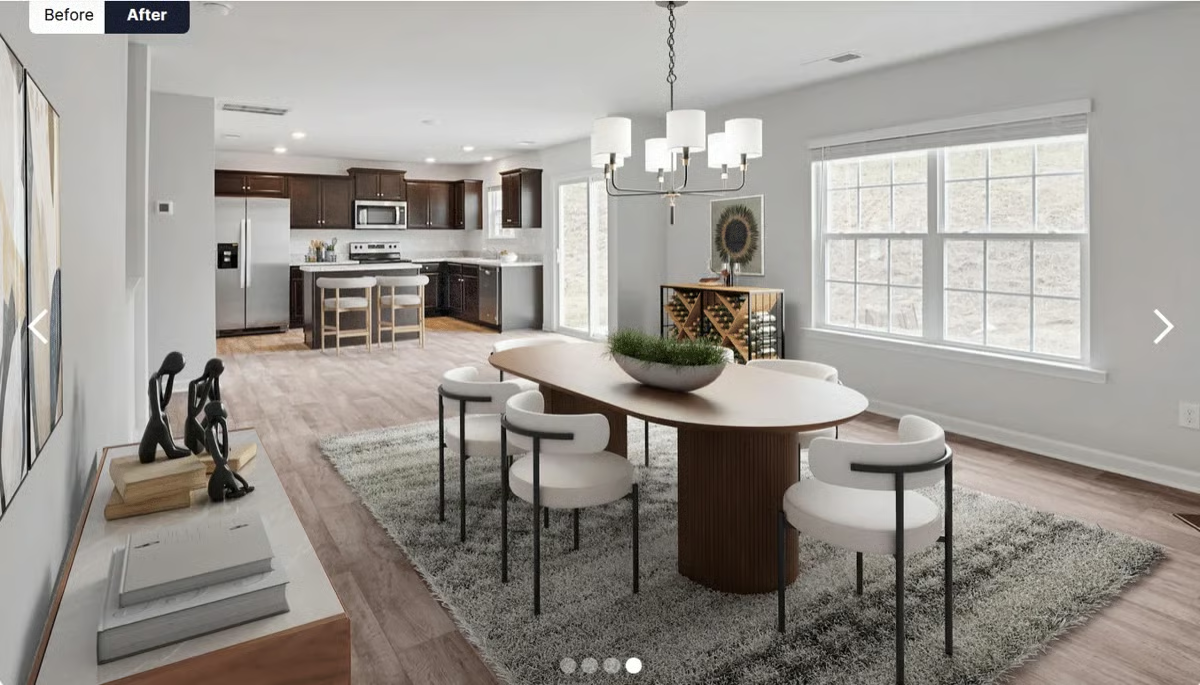
Before making a price reduction, real estate agents should ensure there is nothing more they can do to facilitate more showings and a faster sale. If the CMA is on point, the listing might benefit from home staging and improved curb appeal by cleaning up the front yard and painting. If it’s not in the budget to hire a professional home stager, look into virtual home staging software that allows you to overlay the home’s furnishings and decor with its built-in design options at an affordable price.
After you’ve staged the home and updated the curb appeal, write a new listing description and hire a professional photographer to take new real estate listing photos. If the house doesn’t get more activity and it’s time for a conversation about price improvement, real estate agents want to show the seller supporting market data. Mention these additional efforts to spruce up the listing in the conversation so sellers understand that it wasn’t just a case of the home needing TLC.
Apply Design is an affordable, user-friendly app that allows anyone to stage their listings quickly. It’s one of the only virtual home staging apps on the market that still lets agents do their virtual home staging. It’s also effortless with one-click auto-staging and drag-and-drop features and includes many tasteful, high-quality renderings of furniture, art, lighting, rugs, plants, and decor. It even has a free trial, so you can try it before you buy.
4. Decide on one (or more) price reduction strategies
Whatever the reason, real estate price reductions are a part of real estate sales. Ideally, we want to price it correctly right out of the gate, but sometimes homes don’t sell at the listed price for various reasons. In that case, I have several real estate price reduction strategies you can employ today. As I mentioned, if your comp data shows you’re in the correct pricing ballpark, don’t make a massive price cut—a 5% to 10% increment should suffice.
Strategy 1: Implement a 10-day price drop
If the seller is close enough to the ideal price point and wants to test the waters at their asking price, agree that if the price gets little to no activity or offers, it will automatically drop to your suggested listing price after 10 days. I did this with one of my sellers, who insisted the home was worth $370,000, and my market data showed it was worth $315,000.
We listed it at her price, and it had showings but no buyers. Houses were selling fast and well above listing prices. After 10 days, we dropped her price to $330,000 (within my 10% suggested retail) and sold it for $360,000. She was shocked. I explained how human psychology works when buying real estate. The higher price scared off buyers, but at the right price point, she received competing offers.
Strategy 2: Offer seller financing
This idea isn’t as much a price-reduction strategy as it is about attracting buyers. If the seller can offer full or partial seller financing at slightly better-than-market mortgage rates, a buyer may be willing to pay a little more for the property since they’ll save money on interest payments over time. The seller can get creative with a balloon loan that is amortized across 30 years but is due in full in five to seven years. That way, the seller isn’t locked into it for 30 years, and the buyer can refinance before rates go down.
Strategy 3: Employ targeted marketing
Once you’ve reduced the home’s price, update your listing details and run social media ads with the phrase “Price Reduction Real Estate Sale” or similar. You can use highly targeted social media and Google ads, specifying location, demographics, lifestyle, and interests, to get your listing in front of as many potential buyers as possible.
Don’t forget to update the listing in your MLS so it will syndicate to Zillow, Realtor.com, and other syndicated sites. You can also post it on Craigslist. Employing simultaneous real estate marketing ideas will get the price reduction in front of as many eyes as possible.
Strategy 4: Tap into your agent network
Shortly after doing a price reduction, real estate agents should email agents and brokers in their region. One of your colleagues may have the perfect buyer for your listing. The easiest way to do this is to input all the local agents into your client relationship management (CRM) system so you can write one email to everyone. Include your updated listing photos, and use effective words and phrases to describe the home.
Strategy 5: Send direct mail
In addition to tapping into your network, direct mail is a great marketing strategy for the neighborhood and your sphere of influence. Postcards and flyers are affordable, and you can use colorful graphic designs with information about the house and its new price. Using a service like ProspectsPLUS!, with its Map My Mail feature, you can avoid wasteful spending and target by demographics, lifestyle, and geography. It’s one of my favorite services for postcards and mailers.
Strategy 6: Use ‘odd pricing’
There is an art and science to pricing a house for sale using market data and human psychology. Research has shown that prices ending in 99 sell faster than 00. One reason is when someone is looking at a price, they look at the left digit first. Compare $299,999 to $300,000. Though there is only a $1 difference, the $299,999 seems much lower, right? This strategy is known as the left-digit effect. Try it on your listings.
One caveat: This will not work on overpriced listings! If the seller wants $599,999 for their home and it’s only worth $400,000, all the price finagling in the world will not sell it. However, a $400,000 home listed between $399,999 and $439,999 could sell faster than its rounded-number competitors.
Strategy 7: Offer seller incentives
Seller incentives combined with a price reduction are a real estate powerhouse! They make the listing more competitive and add value to potential buyers. Sellers can offer help with closing costs, a home warranty, or money toward upgrades or repairs.
For example, upgrades could include money for new paint, carpet replacement, or windows. Repairs might include roof replacement or money to fix a crumbling driveway. If the sellers can’t foot the total bill for closing costs, upgrades, or repairs, they can offer a portion or percentage of the expenses.
Strategy 8: List during the off-season
This tip isn’t a price reduction strategy but an opportunity to take advantage of a higher price when fewer competing listings exist. It’s about supply and demand. We’re currently in a competitive seller’s market. Still, fewer homes are available during the winter since people focus on holidays and don’t want to move when it’s cold or snowy.
But it can be a prime time to sell. Buyers needing to relocate quickly may be willing to pay more. One challenge with this strategy is that if the sellers need to find a new home and inventory is tight, it may take longer. They could rent somewhere for a few months until the spring when everyone tends to list their homes, and prices may drop slightly. You must still rely on your market data and price it reasonably.
Have the price reduction conversation with your client
After you’ve decided on the best strategy, it’s time to talk to your clients. Always rely on hard data when talking to sellers and understand the property type and how long it takes to sell. Luxury listings have a smaller buyer pool, so they inherently have a longer sales timeline. Commercial real estate and raw land also can take longer to sell than residential real estate.
Whether discussing a lower price at the listing appointment or planning a price reduction, remember that it can be a sensitive topic for sellers. They’re emotionally invested and often think their home is worth more. Understanding sellers’ emotions allows you to empathize while relying on data. Don’t just tell them the data—you must show them. Bring an updated comparative market analysis (CMA) and current market data report and discuss the details of comparable homes.
Here are five conversation starters you can use in price reduction real estate conversations.
Low-price recovery approach
Remind your sellers that it’s easier to recover from a low price than one that’s too high. A low price will produce multiple offers and create a bidding war. Buyers buy elsewhere when the price is too high. Reducing a home’s price can be a negative in the buyer’s perception. They think that there must be something wrong with the house, and it is now suspect, immediately reducing the pool of buyers who may qualify for the home.
Low-price recovery approach:
Mr. and Mrs. Seller, I can appreciate that you’re worried about underpricing your home, and I also want you to understand that it’s easier to recover from a low price than one that’s too high. When your price is too high, you immediately eliminate qualified buyers who might’ve bought the home. A low price attracts a lot of buyers and has the potential to create a bidding war. Let’s look at this market report and my CMA and ensure we price your home competitively while getting you the best possible price. Does that sound OK?
Supply vs demand approach
Supply and demand drive prices in any market, including real estate. When there is high inventory, prices decrease, and low inventory drives up prices. For the past few years, inventory has been low in many areas, so sellers have been able to command a premium for their homes.
However, in 2022, things started to slow down due to rising mortgage interest rates and home prices out of reach for many. You can use supply and demand to discuss price reduction no matter what market we’re in.
Supply vs demand approach:
I know, Mrs. Seller, that homes had been selling fast and above list price for a few years, but when the Fed increased mortgage interest rates, homebuying slowed significantly. The buyers who qualified for your home just last year may not qualify now because the increased rates put it out of reach. And we’re noticing more homes sitting on the market longer, so there is more supply, even though inventory is still low. The demand has dropped since many buyers no longer qualify for the homes they did at lower rates. Let me show you the data on how many homes are available for sale, how long they’re on the market, and homes like yours that have sold and at what price point. Would that help?
Short sale approach
If the seller has an underwater mortgage, owing more than the home’s current market value, they’re likely hesitant to reduce the price. I’ve seen some agents take the listing at the seller’s price, but this is a disservice to them. It wastes everyone’s time and puts them at greater risk of foreclosure.
Instead, educate them on real estate short sales and have them talk to their lender about the process. Depending on their financials, the balance between the selling price and loan amount may not need repayment but is treated as earned income and a taxable event.
Short sale approach:
Ms. Seller, I understand why you must price your home this high to get out from under your mortgage. Looking at the market data, unfortunately, if I list your home at this price, I’d be doing you an enormous disservice. The house will sit on the market at this price, waste your time, and put you at greater risk of foreclosure. I know you owe more than this, but there may be a solution. Do you know what a real estate short sale is? (Wait for response.) It’s when your lender approves a sale price below what you owe, and you may not have to pay back the difference.
The balance owed may be treated as earned income, where you’d get an IRS 1099 form from the lender and only have to pay taxes on the difference. The first step is to ask your lender if they’d allow a short sale. Then, we’d list your home for the highest possible price based on the market value. Does this sound like something you’d like to pursue?
Low, middle & high approach
There are three prices for a seller’s home: low, middle, and high. When talking to sellers about a price reduction, real estate agents want to provide them with these scenarios and have them pick the one that most aligns with their goals.
How to use the low, middle, and high approach:
Mr. Seller, three scenarios are tied directly to buyer perception of real estate prices. To arrive at the best possible price, we need to look at these scenarios and choose the one to help you reach your goals. The first scenario is if the property is priced below market value. If we put a low price on your home, it will generate a lot of activity and offers quickly, and you can expect to close in four to eight weeks after you accept the best offer.
Scenario two: Based on the updated comps I shared, we price your property at market value or only slightly above. We’ll get an offer within the first dozen showings or a month or two (market-dependent). In the third scenario, if we keep the listing at this price, we may get a few showings but no offers. So far, we’ve had (# of showings) and no (or lowball) offers. Based on this data, we’re out of the pricing ballpark by at least (% between the listed price and market price). Which one of these scenarios will best meet your needs?
Zillow viewers approach
I love the Zillow Viewers approach. This conversation starter is accomplished by showing the seller how many “Views” and “Saves” their property has garnered since listing. Whether there are many or few, the fact is, there are no offers. People look at the listing and pass on. If many visitors save the listing, it may need a minor price adjustment compared to hundreds or thousands of views and few saves.
To use the Zillow Viewers approach, say:
Mr. and Mrs. Seller, I want to share some additional important data about your house. Look at how many people have seen the listing here on Zillow. You have (X number of views) but no offers. Why do you think that is? (Wait for response.) Based on the most recent market analysis I showed you and this information, the data tells us that the price is too high, and you need to be in this ballpark (show them the suggested price on your printed CMA). What are your thoughts?
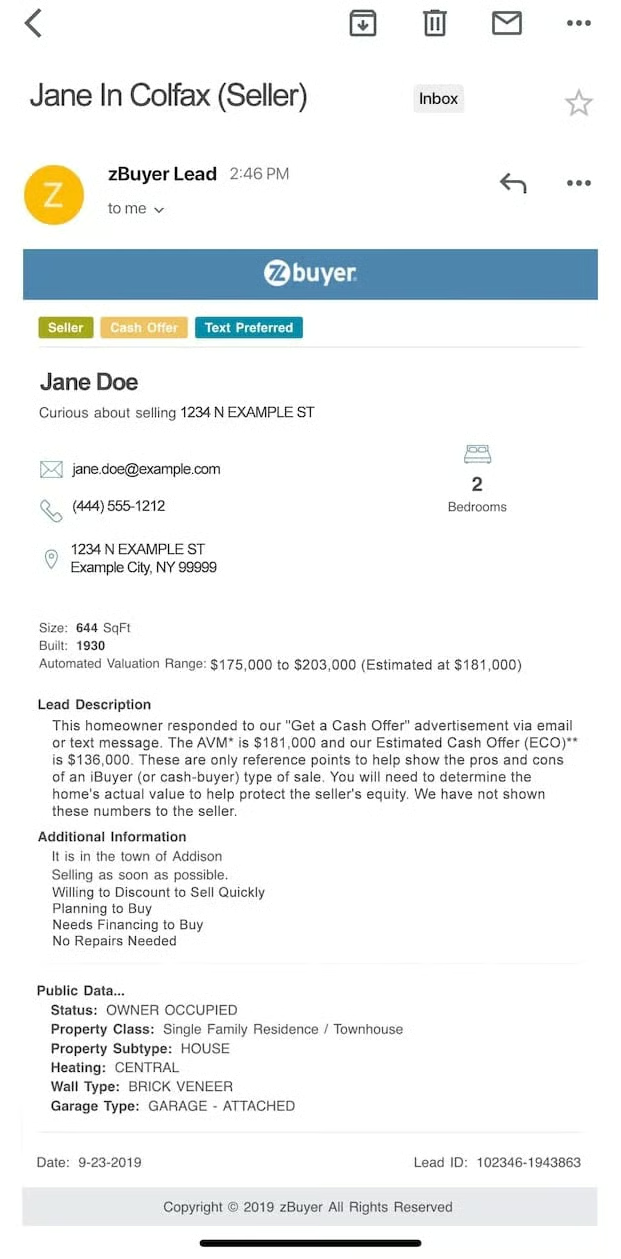
A cash offer is best if home sellers need a quick closing. You can find sellers looking for cash buyers through zBuyer, a real estate lead-gen software that markets to Facebook homeowners interested in getting cash offers for their homes. zBuyer offers these potential sellers a chance to discover their home’s worth and connects them with agents who can help them find cash buyers.
How to avoid price reductions
Agents may be unable to avoid a real estate price reduction, but they can lessen the chances.
Price the home right the first time around
To avoid the hassle of asking the sellers for a price reduction, real estate agents should do their best to get the price right at the initial listing appointment. Taking overpriced listings is a disservice to clients, making you look bad when their homes don’t sell. Generally, I tell sellers to price the house within 10% of the suggested price from my comparative market analysis (CMA). There’s no specific rule, but it’s not a drastic increase preventing the home from selling.
So, a $250,000 home would list no higher than $275,000, and the seller could see offers in that $250,000 range. If you later need a price reduction, going from $275,000 to $250,000 isn’t too drastic a drop where buyers suspect the house has issues. In this scenario, I would suggest a list price of $265,000 in a low inventory market, potentially creating a bidding war with the seller seeing higher offers up to $280,000.
Don’t take those overpriced listings
Overpriced listings are the pariah of the real estate market. Buyers avoid them like the plague. Or, you may get some “lookers” who ultimately walk away and buy the house listed by savvy agents who know how to price them appropriately. If there’s one thing you take away from this article, don’t take overpriced listings.
Here are some reasons why it is critical not to take an overpriced listing:
- Overpriced listings sell competing properties when buyers see what they can get for less.
- When you agree to an overpriced listing, the seller believes you will sell it. They get pretty angry at YOU when it doesn’t sell. They will complain about you to everyone.
- Overpriced listings prevent the sellers from moving forward with their plans.
- Sellers may ultimately get less money for their homes than if the price was right.
Frequently asked questions (FAQs)
What does it mean when a house price is reduced?
There are many possible reasons why a house price is reduced. It could be that the homeowner wanted to try a higher price to test the waters, that the market is slow and houses take time to sell, or that the sellers must relocate quickly. It’s important not to read into why a home’s price dropped since many factors exist.
How soon should you lower your house price?
Agents should strive to price the home at the best possible price upon taking a listing, but if they need to reduce the price, they should show the sellers the market data and comps and reduce the price within 10 days to two weeks of it going on the market. This timing is important because solid buyers may have moved on and purchased something else if you wait too long.
Can a home sell for more after a price reduction?
Yes. I’ve personally seen this happen. A strategic price reduction can attract more buyers, create competition, and generate multiple offers. In some cases, bringing a home closer to market value actually increases demand and leads to a higher final sale price than the seller expected.
What if a seller refuses to reduce the price?
If a seller is unwilling to adjust the price, continue providing market updates, buyer feedback, and listing performance data. Sometimes sellers need more time and information before they’re ready to make a change. The agent’s role is to advise and educate while respecting the seller’s final decision.
Bringing it all together
The best way to avoid a difficult price reduction conversation is to price the home correctly from the start. While no agent wants to revisit pricing after a listing goes live, market conditions, buyer behavior, and showing activity don’t always align with initial expectations. Sometimes, a price adjustment becomes necessary to reposition the property and generate renewed interest.
When that time comes, it’s important to approach the conversation with empathy and data. A well-prepared CMA, recent market activity, showing feedback, and listing performance metrics can help sellers understand the reasoning behind a price change and make informed decisions. While these conversations are rarely easy, they’re often necessary to help sellers achieve their ultimate goal: selling their home.
Related Articles