






































- Key takeaways
- Pocket listings at a glance
- What is a pocket listing?
- How a pocket listing works
- Are pocket listings legal?
- States are starting to crack down on private listings
- Why pocket listings are back in the spotlight
- What Zillow research says about pocket listings
- Pros & cons of pocket listings
- Fair housing & ethics concerns
- When a pocket listing may make sense
- When a pocket listing is risky
- Common pocket listing mistakes agents should avoid
- Alternatives to pocket listings
- Frequently asked questions (FAQs)
- Final takeaway
Key takeaways
- Pocket listings are properties marketed privately instead of broadly exposed through the MLS.
- Pocket listings can be legal, but agents must follow state law, local MLS rules, brokerage policy, fair housing laws, and NAR rules where applicable.
- The biggest benefit of a pocket listing is privacy and control.
- The biggest risk of a pocket listing is limited exposure, which can reduce buyer competition and potentially affect the final sales price.
- Zillow Research found that off-MLS sellers in 2023 and 2024 typically sold for less than comparable MLS-listed sellers, but that research should be read with Zillow’s position in the private listing debate in mind.
- State-level rules are changing, and New York advanced a proposed private listing transparency law in 2026.
A pocket listing is a property that’s for sale but not advertised on a multiple listing service (MLS). Instead, it is shared privately by the listing agent, brokerage, or a limited agent network. Pocket listings are also commonly called off-market listings, private exclusives, or whisper listings, although those terms can have slightly different meanings depending on the brokerage, MLS, and local rules.
Pocket listings have become one of the most debated topics in real estate because they sit at the intersection of seller privacy, market exposure, fair housing, and listing transparency. Some sellers want a quieter sale to protect privacy, avoid public days on market, or test demand before going live. But limited exposure can also reduce competition, restrict buyer access, and create compliance risks for agents.
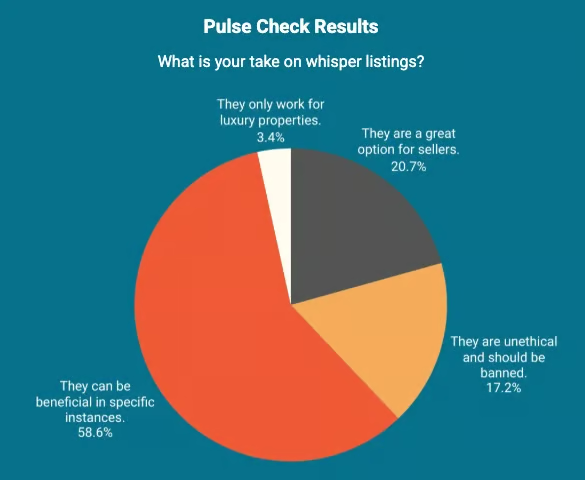
At The Close, I recently asked agents in our newsletter, which reaches more than 100,000 readers, what they think about whisper listings. The response showed just how divided the industry is: 58.6% said they can be beneficial in specific instances, 3.4% said they only work for luxury properties, 20.7% said they are a great option for sellers, and 17.2% said they are unethical and should be banned.
The split in responses tells the story. Pocket listings are not automatically good or bad. They are a strategy, and, like any strategy, they need to be used carefully and legally, in the client’s best interest.
Pocket listings at a glance
| What is a pocket listing? | A property for sale that is not broadly marketed on the MLS and is instead shared privately through an agent, brokerage, or limited network. |
| Is a pocket listing legal? | It can be legal, but agents must follow state law, MLS rules, brokerage policy, fair housing laws, and NAR rules if they are Realtors. |
| Does NAR allow pocket listings? | NAR’s Clear Cooperation Policy limited public marketing outside the MLS, but office exclusives and certain delayed-marketing options may still be allowed depending on local rules. |
| Why would a seller want a pocket listing? | Privacy, security, tenant concerns, legal situations, or a desire to test interest before a full public launch. |
| What is the biggest risk for pocket listings? | Limited exposure can reduce buyer competition and may raise fair housing, transparency, or fiduciary duty concerns. |
| Who should be cautious about pocket listings? | Agents, because rules vary by state, brokerage, and MLS, and public marketing can trigger compliance requirements quickly. |
What is a pocket listing?
A pocket listing is a property that a seller agrees to market privately rather than listing it on the MLS for broad public exposure. The home is not widely advertised on public listing websites, and buyers may not see it unless their agent has access to the listing agent, brokerage, or private network where the home is being shared.
The term “pocket listing” comes from the idea that an agent has a listing “in their pocket” rather than out in the open market. The newer term “whisper listing” captures the same idea: a home quietly shared through selective conversations instead of public marketing.

In practice, a pocket listing might be shared with a small group of agents, a brokerage’s internal network, a private listing platform, a database of qualified buyers, or a few investors. The seller may choose this route because they want privacy, fewer showings, a quieter process, or a way to gauge buyer interest before going public.
The trade-off exposure. When a property is not widely marketed, fewer buyers may know it is available. That can reduce competition, which may affect the final sales price.
How a pocket listing works
A pocket listing usually starts with a seller who does not want a traditional public launch. The seller and agent discuss the reasons for keeping the property private, the potential benefits, and the risks of limiting exposure.
The seller then signs a listing agreement and gives written instructions about how the property should be marketed. The step is critical. Agents should document the seller’s consent, clearly explain the trade-offs, and confirm that the private marketing plan complies with local MLS rules, state law, brokerage policy, fair housing requirements, and NAR rules, where applicable.
From there, the agent may quietly share the property with qualified buyers, other agents inside the brokerage, selected buyer agents, or private listing networks. Showings are usually more controlled, and the seller may avoid public open houses, online photos, yard signs, and broad advertising.
If the seller receives an acceptable offer, the transaction moves forward like any other sale. If the private strategy does not yield the desired result, the seller and agent may decide to list the property on the MLS for broader exposure.
Are pocket listings legal?
Pocket listings can be legal, but they are not a free-for-all. Whether a pocket listing is allowed depends on state law, local MLS rules, brokerage policy, fair housing requirements, and whether the agent is a Realtor bound by NAR rules.
For Realtors, the biggest rule to understand is NAR’s Clear Cooperation Policy. Under that policy, once a listing is publicly marketed, it generally must be submitted to the MLS within one business day. Public marketing can include signs, flyers, brokerage websites, email blasts, social media posts, digital ads, and other public-facing promotion.

That does not mean every private listing is banned. Office exclusives can still exist when a seller directs the listing broker to market the property only within the broker’s firm, subject to local MLS rules and required seller documentation. In 2025, NAR kept Clear Cooperation in place but added more flexibility around delayed marketing, allowing sellers in some MLSs to keep listings from being distributed to public portals for a period of time while still making them available inside the MLS.
The safest answer is this: pocket listings may be allowed in certain situations, but agents should never assume they are automatically compliant. Before marketing a property privately, confirm the rules with your broker, local MLS, and state licensing authority.
States are starting to crack down on private listings
The pocket listing debate is no longer limited to MLS rules and brokerage policies. Some states are now moving to restrict private listings through legislation. In New York, lawmakers advanced the proposed Fair and Transparent Real Estate Listing Act in 2026. If signed into law, the bill would require real estate agents to market properties through free or publicly accessible channels instead of private or exclusive networks, unless the seller signs an agreement acknowledging the risks of limited exposure. Those risks include reduced visibility, fewer offers, and a potentially lower final sale price.
The proposed New York law follows similar efforts in other states. Washington and Connecticut have passed private listing transparency laws, and lawmakers in Illinois and Hawaii have also considered similar proposals. The goal of these measures is not necessarily to eliminate every private sale, but to ensure sellers understand what they may be giving up when they choose limited exposure.
For agents, this is an important shift. Pocket listings are no longer just a question of NAR policy or local MLS rules. In some markets, state law may also shape how private listings can be marketed, what sellers must disclose, and what penalties agents may face for noncompliance.
Why pocket listings are back in the spotlight
Pocket listings are getting renewed attention because the real estate industry is split over how much control sellers should have over listing exposure and how much access buyers should have to available inventory. Brokerages that support private listings argue that sellers should be able to decide when and where their home is marketed. Critics argue that private listing networks reduce transparency, limit buyer access, and can make the housing market feel fragmented.
That debate has also turned into a legal fight. Compass sued Zillow over Zillow’s Listing Access Standards, which can block listings from Zillow and partner sites if they are publicly marketed elsewhere before being made broadly available. Compass argued that Zillow’s policy restricts seller choice and competition, while Zillow said its policy supports transparency and a fairer market.
The fight escalated again in 2026 when Zillow lost access to thousands of Chicago-area listings during a dispute with Midwest Real Estate Data (MRED), the region’s MLS provider. Zillow sued MRED and Compass, alleging that private listing practices were hiding homes and harming buyers, sellers, and competition. MRED pushed back, refusing to display certain listings. A federal judge later ordered MRED to restore Zillow’s access to its database.
For agents, the takeaway is that pocket listings are no longer just a quiet luxury strategy. They are part of a larger debate over seller choice, MLS rules, portal visibility, brokerage control, and consumer access. That makes documentation, compliance, and seller education more important than ever.
What Zillow research says about pocket listings
One of the biggest risks of a pocket listing is that limited exposure can decrease competition. According to Zillow Research, home sellers who sold off the MLS in 2023 and 2024 collectively left more than $1 billion on the table. Zillow found that the typical off-MLS seller sold for $4,975 less than comparable sellers who listed on the MLS, a median loss of 1.5% nationwide.
It is important to note that this research comes from Zillow, a company that has publicly supported broad listing access and taken a strong position against certain private listing practices. That does not make the data irrelevant, but it does mean agents and sellers should read it with that context in mind. The study remains useful because it highlights the financial risks sellers may face when they limit their exposure to the full MLS marketplace.
The impact was larger in some states. Zillow found that California sellers who sold off the MLS typically lost $30,075, while sellers in New York lost $13,749 and sellers in Massachusetts lost $20,171. Zillow also found that off-MLS sales underperformed across all price tiers, with the largest percentage hit among lower-priced homes.
That matters because pocket listings are often marketed as a way to create privacy, exclusivity, or control. Those benefits can be real for certain sellers, but they come with a trade-off. When a home is not exposed to the full MLS marketplace, fewer buyers may know it is available, which can reduce competition and potentially lower the final sale price.
Pros & cons of pocket listings
| Pros | Cons |
|---|---|
|
|
|
|
|
|
|
|
|
|
|
|
Fair housing & ethics concerns
Pocket listings can create fair housing risk because access to the property is limited by design. If a listing is shared only with a small group of agents, buyers, investors, or social circles, qualified buyers outside that network may never know the home is available.
That does not automatically mean every pocket listing violates fair housing law. But agents need to be careful about how the listing is shared, who gets access, and whether the marketing plan could unintentionally exclude protected classes. The federal Fair Housing Act prohibits discrimination based on race, color, religion, sex, disability, familial status, and national origin.

Agents can reduce risk by documenting the seller’s instructions, using objective buyer criteria, sharing the property through inclusive private channels when allowed, avoiding assumptions about who “fits” a property, and presenting all qualified offers fairly. Agents should also follow Article 10 of the NAR Code of Ethics, state fair housing laws, and local MLS rules.
The ethical test is simple: is the private strategy serving the seller’s documented goals, or is it mainly benefiting the agent or brokerage? If the goal is privacy, security, timing, or a specific seller need, a private strategy may be appropriate. If the goal is to limit competition, double-end a deal, or keep inventory away from other agents, that is a red flag.
When a pocket listing may make sense
A pocket listing may make sense when the seller has a clear privacy, security, or timing reason for limiting exposure. This can include high-profile sellers, divorce, estate situations, tenant-occupied properties, homes undergoing repairs, or sellers who are not ready for public marketing but would consider the right offer.
It may also make sense when a seller understands the trade-offs and still prioritizes discretion over maximum exposure. The key is informed consent. Sellers should understand that limited public marketing may reduce the buyer pool, reduce competition, and affect final sale price.
For agents, the private strategy should be tied to the seller’s needs, not the agent’s desire to control both sides of the deal. The main reason for keeping the listing private should not be agent convenience or commission control.
When a pocket listing is risky
A pocket listing can be risky when the seller wants the highest possible price, broad competition, or maximum exposure. If the property would benefit from open market demand, keeping it private may limit the number of offers and reduce negotiating leverage.
Pocket listings are also risky when the seller has not been fully educated on the trade-offs. Agents should document the seller’s instructions, explain the exposure limits, and show how the private strategy compares with a standard MLS listing.
The risk is even higher if the agent’s private buyer network is narrow, non-diverse, or likely to exclude qualified buyers. That can create fair housing concerns and undermine the seller’s access to the full market.
Common pocket listing mistakes agents should avoid
The biggest mistake agents make with pocket listings is treating them as a casual workaround instead of a compliance-sensitive listing strategy. A private listing should start with the seller’s documented goals, not the agent’s desire to control the transaction.
Agents should avoid these common mistakes:
- Publicly teasing the property before confirming MLS rules
- Assuming “private” means exempt from fair housing laws
- Failing to get written seller consent
- Marketing only to a narrow or non-diverse buyer pool
- Presenting a pocket listing as a guaranteed way to get a better deal
- Using private marketing mainly to double-end the transaction
- Forgetting to explain the potential financial trade-off of limited exposure
- Failing to create a clear plan for moving the property to the MLS if needed
A pocket listing can be appropriate in specific situations, but it should never be used to avoid transparency, unfairly limit competition, or put the agent’s interests ahead of the seller’s.
Alternatives to pocket listings
Pocket listings are not the only option for sellers who want more control, privacy, or flexibility. Depending on the seller’s goals, one of these alternatives may offer a better balance between discretion and exposure.
| Alternative | What it is | Best for | Key trade-off |
|---|---|---|---|
| Office exclusive | A listing marketed only within the listing brokerage under specific MLS/NAR rules. | Sellers who want privacy but still want agent representation. | Limited buyer pool and strict compliance requirements. |
| Coming soon listing | A pre-market MLS status that allows a property to build interest before going fully active. | Sellers preparing the home for showings or photos. | Must follow MLS timelines and showing rules. |
| Delayed marketing listing | A listing entered into the MLS with public display delayed where allowed by MLS rules. | Sellers who need privacy or preparation time but still want MLS structure. | Rules vary by MLS and may limit public visibility. |
| Standard MLS listing | A publicly marketed listing distributed through the MLS and major listing portals. | Sellers who want maximum exposure and competition. | Less privacy and more public attention. |
| Private exclusive network | A brokerage or private network where listings are shared with select agents or buyers. | Sellers prioritizing control or exclusivity. | May reduce transparency and buyer access. |
| Direct cash buyer | A sale directly to an investor or house-buying company, often as-is | Sellers who need speed or simplicity. | Often results in a lower sale price. |
Frequently asked questions (FAQs)
What is the difference between a pocket listing and an office exclusive?
A pocket listing is a general term for a privately marketed listing. An office exclusive is a specific type of private listing where the seller directs the listing broker to market the property only within the broker’s firm, subject to MLS and seller certification rules.
Are pocket listings good for buyers?
Pocket listings can give buyers access to homes that are not widely marketed, but buyers should still do their due diligence. A private listing is not automatically a good deal, and limited competition does not always mean a lower price.
Can a seller change their mind after choosing a pocket listing?
Yes. A seller can usually change direction and move the property to the MLS, depending on the listing agreement, brokerage policy, and local MLS rules. Agents should discuss this backup plan before starting a private listing strategy so the seller knows when and how the home would be publicly marketed if the pocket listing does not produce the right offer.
Are pocket listings more common in luxury real estate?
Pocket listings are often associated with luxury real estate because high-profile sellers may prioritize privacy, security, and discretion. However, they are not limited to luxury homes. They can also appear in tenant-occupied properties, estate sales, divorce situations, pre-marketing testing, or investor-heavy transactions.
Final takeaway
Pocket listings can still have a place in real estate, but they require more caution than ever. For sellers, the appeal is privacy, control, and discretion. For buyers, the appeal is access to inventory that may not be widely visible. For agents, however, the responsibility is greater: explain the trade-offs, document the seller’s instructions, follow MLS and NAR rules, and ensure the marketing plan does not create fair housing or fiduciary risk.
The safest approach is to treat a pocket listing as a specific strategy for a specific seller need, not a default way to sell a home. When privacy matters most, a private listing may make sense. When price, exposure, and competition matter most, the open market is usually the stronger path.
Related Articles